


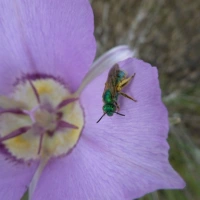


We’re on our way to Pierre’s Hole:

Pierre’s Hole, Looking East to the Grand Tetons. Source
Back in 1834, at least one man thought it looked like this:
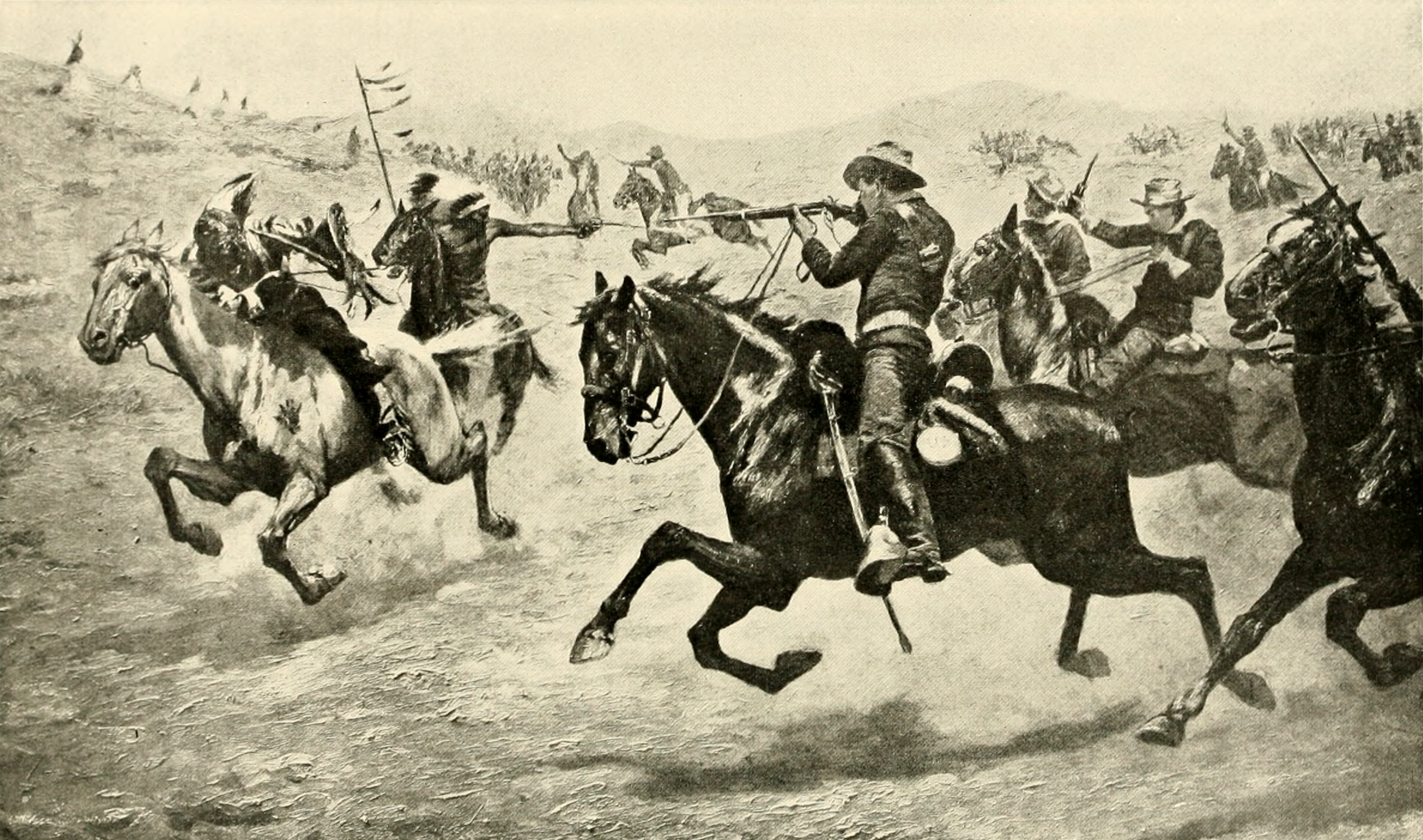
The Battle of Pierre’s Hole
Image from Joseph Gaston’s Centennial History of Oregon. Before 1910. Artist unknown. Source.
There was a day of treachery and shooting: July 17, 1832. The tensions of a half century of the old Northwest came to a head that day after two French Canadian Haudenosaunee métis men, Antoine Godin and another, identified either as a “Flathead” (Salish) chief or Baptiste Dorion, grandson of Lewis and Clarke’s Sioux interpreter Pierre Dorian, murdered an Atsina chief offering peace — or appearing to. First, though, some irony: a hole is a haunt, a place to “hole up”, the place a wild animal retreats to for safety, or as dictionary.com says:
Like this marmot:
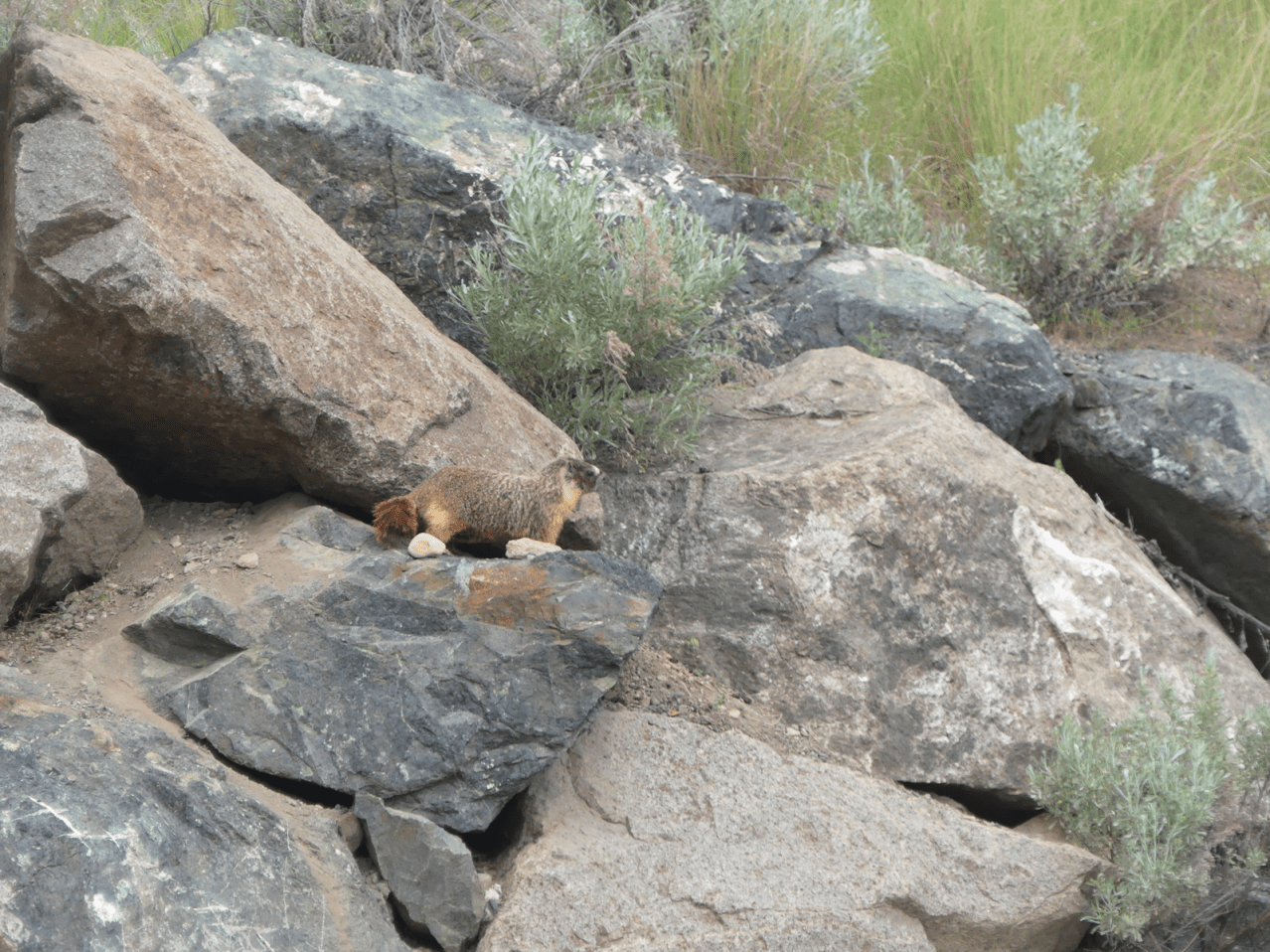
A Marmot and His Hole, Vernon, British Columbia. Photo by Harold Rhenisch
Or a man, like Pierre Tevanitagon, a Haudenosaunee from Kahanawake. This valley in the Rocky Mountains was Pierre’s hole. He went to ground here after abandoning Peter Skene Ogden’s 1824 expedition to deny American access to the west (and force trade with the HBC) by killing every beaver in the Middle and Southern Rocky Mountains. Pierre Dorion (father of Baptiste Dorion, who may or may not have been the shooter at Pierre’s Hole) left with him. Godin, who started the battle at Pierre’s Hole, left Ogden’s expedition in 1825. You can read about Ogden’s environmental destruction and social enslavement here: https://okanaganokanogan.com/2022/11/27/35-the-long-arm-of-new-france-war-by-other-means-part-2/ Let me just add two points:
First,
expeditions like Ogden’s were dangerous. The killing of Indigenous ancestors…
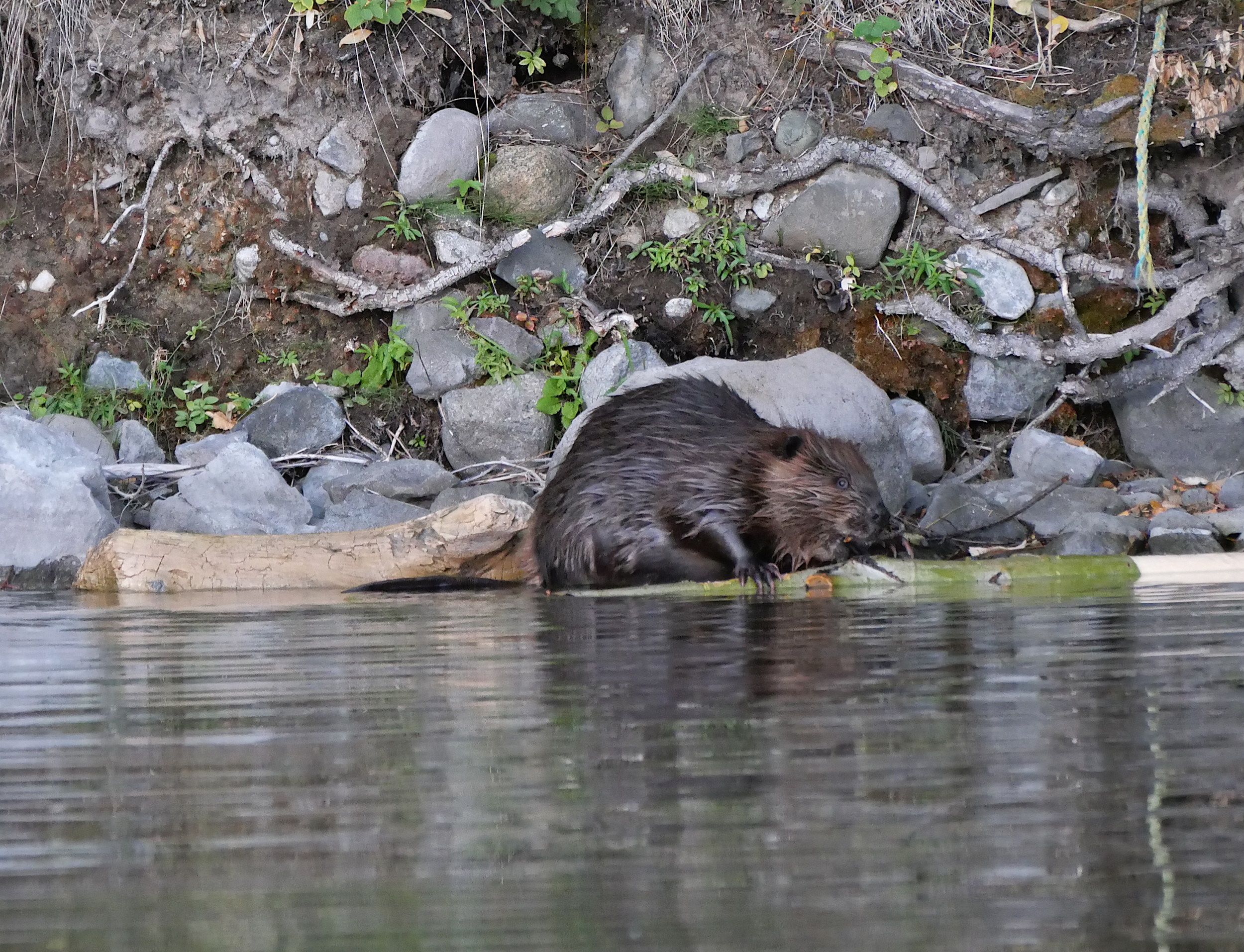
Stunx, the Water Keeper. A Top-Notch Ancestor. Photo by Harold Rhenisch
… without the permission of their relatives, the Shoshones, the Bannocks, the Utes, and the Nimiípu’u meant that the land the expedition entered, not to mention the land the American traders entered from the East, was fought for by local people, who often saw the goods and horses of the expeditions as more profitable to them than their already nearly-extirpated beavers. Here’s a list of encounters that Ogden recorded after his 1825 expedition:
- November 21, 1825. For three weeks, the troop is followed by Walla Walla men, who raid their horses, then return them for ransom, usually ball and shot.
- December 12, 1825. An HBC slave was killed by Joseph Despard after an argument and a fist fight.
- December 12-February 17, 1826. The expedition is starving in the cold and snow. The Shoshones have sensibly left for the winter.
- February 17. They reach the Payettes River, where 3 Hawaiians, formerly indentured labourers for the HBC working at the time for the Pacific Fur Company because of the terms of the treaty ending the War of 1812, were killed in 1819. It became known as the Owyhee River (Hawaiian River).
- February 18. They reach the Sandwich Island River, where 2 more Hawaiians were killed. Across is Reed’s River, where another party of the Pacific Fur Company, 11 Americans led by a Mr. Reid, were killed by a mixed American-Shoshone group. 3 days after that, 2 Canadians were killed at the mouth of Reed’s River, where Donald McKenzie had built the rudiments of a trading fort. This must have been a defensive skirmish, because the rest of the Canadians, Iroquois and French, were set free, after their goods were taken.
- February 19-March 17. They continue to starve.
- March 18. They execute a Shoshone who came to trade after he knocked down a woman from their troop to steal the beads from her dress.
- March 20. They reach the site where one of Ogden’s men was killed in a Blackfoot raid the spring before. They meet large numbers of Shoshones fleeing rumours of an ongoing Blackfoot raid. Ogden remarks that the Blackfoot are going to soon die out because of the violence of these raids.
- March 24. They meet the Shoshone group, flying an American flag at the mouth of the Raft River. They inform them that the Americans were on Bear’s River in February.
- March 25. Because of the ongoing theft of horses between the Shoshones and Blackfoot, they set a guard on their horses now, but lose 13 beaver traps to theft. They meet up with the Blackfeet and the Piegans, all out to steal horses from the Shoshones.
- April 1. They meet up with a group of Nimiípu’u, out to steal horses from the Shoshones.
- April 3. They are at Benoit’s grave, who died in a skirmish the year before.
- April 7. They are surrounded by various tribes, all intent on stealing horses, from them if need be.
- April 9. Still harried by Blackfoot horse thieves, they meet up with a party of American traders and a group of their own men, who had deserted to the Americans the year before.
- April 10. Mr. McKay kills a man attempting to steal a horse. The deserters, including Pierre, pay their debts.
- April 11. Defectors, Antoine Godin’s son, Young Findlay, and Lounge (a Canadian), leave the Americans for the HBC camp.
- April 15. The Piegans set fire to the prairie to harass the group.
- April 22. Ogden beats three Métis Canadian men for trying to defect to the Americans, and steals their horses.
- May 21. The Shoshone inform them that the Americans are just ahead of them.
Note: by Americans, is meant “men working for fur companies based in St. Louis.” They were largely the same French, Métis, Iroquois and Canadian men who worked for the HBC, although under the leadership of American merchants.
The next day, there’s a reckoning across the British-American-Spanish divide. This is, after all, the real border between Britain and the United States, north-south along the Rocky Mountains between California and Blackfoot Country. It is also country that had long been denied to the French by Sioux slaving raids into Shoshone Country, just as the Blackfeet were denying Americans access to the North, to control access to HBC weapons for themselves. Here’s Ogden, following in their footsteps and scribbling it all down:
Sunday 22nd. As we were on the eve of Starting this Morning one of our Trappers arrived in Company with two of our Freemen who deserted from the Flat Head Post 1822 they belong to a party of 30 men who were fitted out by the Spainards & Traders on the Missouri & have Spent the winter in this quarter & have met with little Success of the 14 who deserted 6 are dead & the remainder with the Spaniards, at St. Louis & Missouri from the information obtained from them we are now 15 days march from the Spainish Village, the whole Country overrun with Americans & Canadians all in the pursuit of the Same object of this we had Convincing proofs this Spring on Bears River & now here for this party know nothing of the others, it appears we are now on the Utas Lands who they represent as being most friendly to the Whites, they have about 20 with them, the Americans had a battle last fall with the Snakes & of the former & one of our deserters Patrick O’Connor were killed & only one Snake fell – there is no water
Source: https://user.xmission.com/~drudy/mtman/html/ogdenjrl.html
That’s not all. Here are his notes from the next day, when the Americans arrive and start trying to lure Ogden’s men away with a price-per-beaver exceeding actual trade value:
Monday 23rd. Remd. in Camp in expectation of the arrival of our absent party, early in the day a party of 15 men Canadians & Spainards headed by one Provost & Francois one of our deserters, arrived, and also in the afternoon arrived in Company with 14 of our absent men a party of 25 Americans with Colours flying the later party headed by one Gardner they encamped within 100 yards of our encampment & lost no time in informing all hands in Camp that they were in the United States Territories & were all free indebted or engaged & to add to this they would pay Cash for their Beaver 3 1/2 dollars p. lb., & their goods cheap in proportion our Freemen in lieu of Seeking Beaver have been with the Americans no doubt plotting.
Source: https://user.xmission.com/~drudy/mtman/html/ogdenjrl.html
Things are tense. Ogden continues the next day, scribbling as usual:
Tuesday 24th. This morning Gardner came to my Tent after a few words of no import, he questioned me as follows Do you know in whose Country you are? to which I made answer that I did not as it was not determined between Great Britain America to whom it belonged, to which he made answer that it was that it had been ceded to the latter & as I had no license to trap or trade to return from whence I came to this I made answer when we receive orders from the British Government we Shall obey, then he replied remain at your peril, he then departed & seeing him go into John Grey an American & half Iroquois Tent one of my Freemen I followed him, on entering this Villain Grey said I must now tell you that all the Iroquois as well as myself have long wished for an opportunity to join the Americans & if we did not Sooner it was owing to our bad luck in not meeting with them, but now we go & all you Can Say Cannot prevent us, Gardner was Silent having only made one remark as follows, you have had these men already too long in your Service & have most Shamefully imposed on them selling them goods at high prices & giving them nothing for their Skins on which he retired, Grey then said that is true and alluding to the gentlemen he had been with in the Columbia they are Says he the greatest Villains in the World & if they were here this day I would Shoot them but as for you Sir you have dealt fair with me & with us all, but go we will we are now in a free Country & have Friends here to Support us & if every man in the Camp does not leave you they do not Seek their own interest, he then gave orders to his Partners to raise Camp & immediately all the Iroquois were in motion, & made ready to Start this example was Soon followed by others at this time the Americans headed by Gardner & accompanied by two of our Iroquois who had been with them the last two years advanced to Support & assist all who were inclined to desert, Lazard an Iroquois now Called out we are Superior in numbers to them let us fire & pillage them on Saying this he advanced with his Gun Cocked & pointed at me but finding I was determined not to allow him or others to pillage us of our Horses as they had already taken two say Old Pierres which had been lent him, they desisted & we Secured the ten Horses but not without enduring the most opprobious terms they could think of from both Americans & Iroquois all this time with the exception of Messrs. Kittson & McKay & two of the engaged men & the latter not before they were Called Came to our assistance thus we were overpowered by numbers these Villains 11 in number with Duford, Perrault and Kanota escaped with their Furs in fact some of them had conveyed theirs in the night to the American Camp. A Carson & Annance paid their debts & followed the example of the others, I cannot but Consider it a fortunate Circumstance I did not fire for had I I have not the least doubt all was gone, property & furs indeed this was their plan that I should fire assuredly they did all they Could to make me but I was fully aware of their plan & by that means Saved what remains – they Started & encamped about half a mile from us. From the above affair I am now Convinced the 6 absent men they have Secured & it would be folly in me to delay my departure for their arrival, indeed I fear many of the Freemen will yet leave us.
Source https://user.xmission.com/~drudy/mtman/html/ogdenjrl.html
11 men defected! Perhaps 6 more! As if that’s not bad enough, things get worse. Threats of a general war are made, independent of the actions or knowledge of either the US or British governments! Ogden gives up all pretense of organization and spills out his frustration at speed:
Wednesday 25th.-Late last evening I was informed the Iroquois & Americans intended to attack & pillage the Camp on hearing this I conversed with Some of the Freemen & engaged men to know if they would assist in defending the Company’s property in Case of attack and they said they would we made all necessary preparations in Case of attack & kept Strict guard during the Night, at day light I gave the Call to raise Camp, scarcely had we begun loading our Horses, when the Americans & three of our Iroquois Came to our Camp but finding us prepared kept quiet Soon after Mr. Montour, Clement & Prudhomme came forward & told me they intended joining the Americans that they were free & not indebted I endeavored to reason with Mr. Montour but all in vain, the reasons he gave for his villany were the Company turned me out of doors they have £260 of my money in their hands which they intend to defraud me of as they have refused to give me interest for but they may keep it now for my debt & Prudhoms. which we have Contracted in the Columbia as for Clement he has a Balce. in the Compys. Book; go we will where we shall be paid for our Furs & not be imposed & cheated as we are in the Columbia – they were immediately Surrounded by the Americans who assisted them in loading & like all Villains appeared to exult in their Villany we then Started but on my mounting my Horse Gardner Came forward & Said you will See us shortly not only in the Columbia but at the Flat Heads & Cootanies we are determined you Shall no longer remain in our Territory. to this I made answer when we Should receive orders from our Government to leave the Columbia we would but Not before to this he replied our Troops will make you this Fall we then parted & proceeded to our encampment of the 19th Inst. and encamped. Here I am now with only 20 Trappers Surrounded on all Sides by enemies & our expectations and hopes blasted for returns this year, to remain in this quarter any longer it would merely be to trap Beaver for the Americans for I Seriously apprehend there are Still more of the Trappers who would Willingly join them indeed the tempting offers made them independent the low price they Sell their goods are too great for them to resist & altho’ I represented to them all these offers were held out to them as so many baits Still it is without effect I have now no other alternative left but direct my Course towards Salmon River without loss of time, to follow up my Second intentions in proceeding by the Walla Walla route is now in a manner rendered impracticable as our numbers are by far too few, as nearly one half of the Trappers are determined to return to Fort des Prairies so if we divide again neither party would Stand a chance of ever reaching the Columbia, there is now No alternative I must bend & Submit to the will of the party.
Source https://user.xmission.com/~drudy/mtman/html/ogdenjrl.html
Then some mixed news:
Thursday 26th.-Late last evening two of the six absent men joined us they had Seen nothing of the remaining four By their accounts as they were on their return to the Camp yesterday they fell in with an American party from 30 to 40 men as they Say Troops, who on Seeing them Called to them to advance which they did, their traps 15 in number 16 Beaver & their two Horses were taken from them they were then told if they would remain with them & not return & Join me their property would be restored to them otherwise not, they were Strictly guarded during the day & while in the act of changing Watches about midnight last night they effected their escape leaving all behind them how far this is Correct I cannot Say it may be probably made to Suit intentions as they have both Women & Horses perhaps they will now Watch an opportunity to return if they do which they Can easily effect without their Furs both day & night we shall however watch them, we raised Camp & encamped at our encampment of the 14th.
Source https://user.xmission.com/~drudy/mtman/html/ogdenjrl.html
And all this time, they continue to trap beaver!
After Ogden’s mile-long caravan of trappers, horses, pelts andtheir wives and children breaks away from the Americans, things continue as usual:
- June 2. They meet a Shoshone, who had stolen their gear a year before, a year after murdering 9 Americans (and stealing all their gear), as well as the gear of a succeeding group of Americans.
- June 3. Ogden reports that the only way to get food from the Shoshones is to steal it by force and then pay them back later. That he expected open welcome instead is quite astonishing.
- June 8. They encounter a Shoshone group who have stolen 180 traps, as well as guns and knives, from the Americans, and have set themselves up as traders in their own right. The Americans are on their trail, hoping to destroy them.
- June 10-11. They are followed by Shoshones intent on stealing their horses. There is a skirmish. None are killed.
To sum up: 3500 beavers, a few other furs, for a value of £2533.18. With the cost of wages and supplies, and especially the death of so many horses bought at inflated prices along the way and which they were later forced to eat, there was in the end neither an immediate profit or loss.
Except for all the death. Just the reported deaths here, from 2 HBC expeditions, 1 Spanish one, and 5 American ones over 2 years, adds up to 30, and even that a tiny fraction of the total for the mountains as a whole. Previous expeditions entered valleys to trap for beaver only after gunfights with their Indigenous watch keepers, which left hundreds dead. What’s more, a decade after Ogden’s expedition almost all of Ogden’s men had died in this ongoing war, where people fought for beavers, with guns bought with beavers, against the men who sold them the guns. That’s to say, Ogden’s men, the Mixed Blood sons of New France, the Hudson’s Bay Company and the Northwest Company died out there, whoever they were working for, and thousands of Indigenous men with them. If that’s not a war, what is? This?

Prigoshyn and a Couple of His Wagner Group Mercenaries in Ukraine. Photo from the New York Times.
Second,
As evident in Ogden’s notes above, tensions were tight and nerves were frayed in this proxy war, but it did not begin here. Shortly before, men such as Ogden had been caught up in the mercantile battle turned violent between the Hudson Bay Company and the Northwest Company in Assiniboia.
Note: The early part of this history lays out how Sioux slaving practices influenced the history of the Pacific Northwest. These notes are followed by pieces demonstrating how the practices became entangled with the HBC trade monopoly through the development of Assiniboia, on the Red River, in the middle of the continent. Here it is again:
To sum up: Assiniboia was created to use the tribal loyalties of Highland Scots to block the northward migration of American settlers, just as the Scots themselves had blocked the northward aspirations of England. It was like having an army without expense. It also interfered with Métis and French Canadian aspirations. All this is a pre-staging of the mess at Pierre’s Hole. Here’s a point that the American historian Joseph Gaston…

Joseph Gaston: Railroadman, Republican Newspaperman and Rancher. Source: https://upload.wikimedia.org/wikipedia/commons/9/90/Joseph_Gaston_from_1911_book.png
…described fairly accurately:

The point is well-made, although a bit over-dramatically. The king was checked: by parliament, which, in the end, gave Gaston’s Oregon the HBC lands. Still, Gaston’s hyperbole…

… is stirring stuff, which the settlement process at Pierre’s Hole shows as more wishful thinking than anything, let alone Gardner’s threats to Ogden in 1826 that he would join with the Salish and the Kutenaxa to drive the HBC out of the Pacific Northwest, without recourse to any court or legislature. Gaston was a French protestant, driven out by a Catholic regime. He was, perhaps, a bit touchy, but his version became history, through his The Centennial History of Oregon, 1811-1912. It was just another salvo in a long-running proxy war. The Haudenosaunee knew this struggle well. This great people, who had sided with the British in the War of 1812 in order to protect their homelands in the Northwest…

The Old Northwest in 1792. The Haudenosaunee Empire filled much of this region.
After they saved British North America by allying with the British against the Americans during the American Revolutionary War, the British gave the southern portion of these lands to the Americans in 1779. After they saved British North America by allying with the British against the Americans during the War of 1812, the British gave the northern portion of these lands to the Americans in the 1814 Treaty of Ghent. Suddenly the Haudenosaunee were homeless.
You can view some more maps here:
It’s no wonder Haudenosaunee men went to the far western portion of the the Northwest with The Northwest Company and its American competitors, both immediately before the war and immediately after the treaty. It was a proxy war of its own. It’s also no wonder that Haudenosaunee feelings towards the British of the HBC were mixed at best, or why they didn’t just simply go to the Americans. The Haudenosaunee remained independent actors, as they had always been, choosing allegiances to suit their circumstances, only now without an empire or much beyond individual power. In other words, they were deeply modern men.

Ignace and his canvas camera studio backdrop. He came with David Thompson of the Northwest Company in 1809 — to lands his people had traded in for generations. Source
Even in 1797, the Haudenosaunee plight had been desperate. As Colin G. Calloway puts it in his book White People, Indians, and Highlanders: Tribal Peoples and Colonial Encounters in Scotland and America:
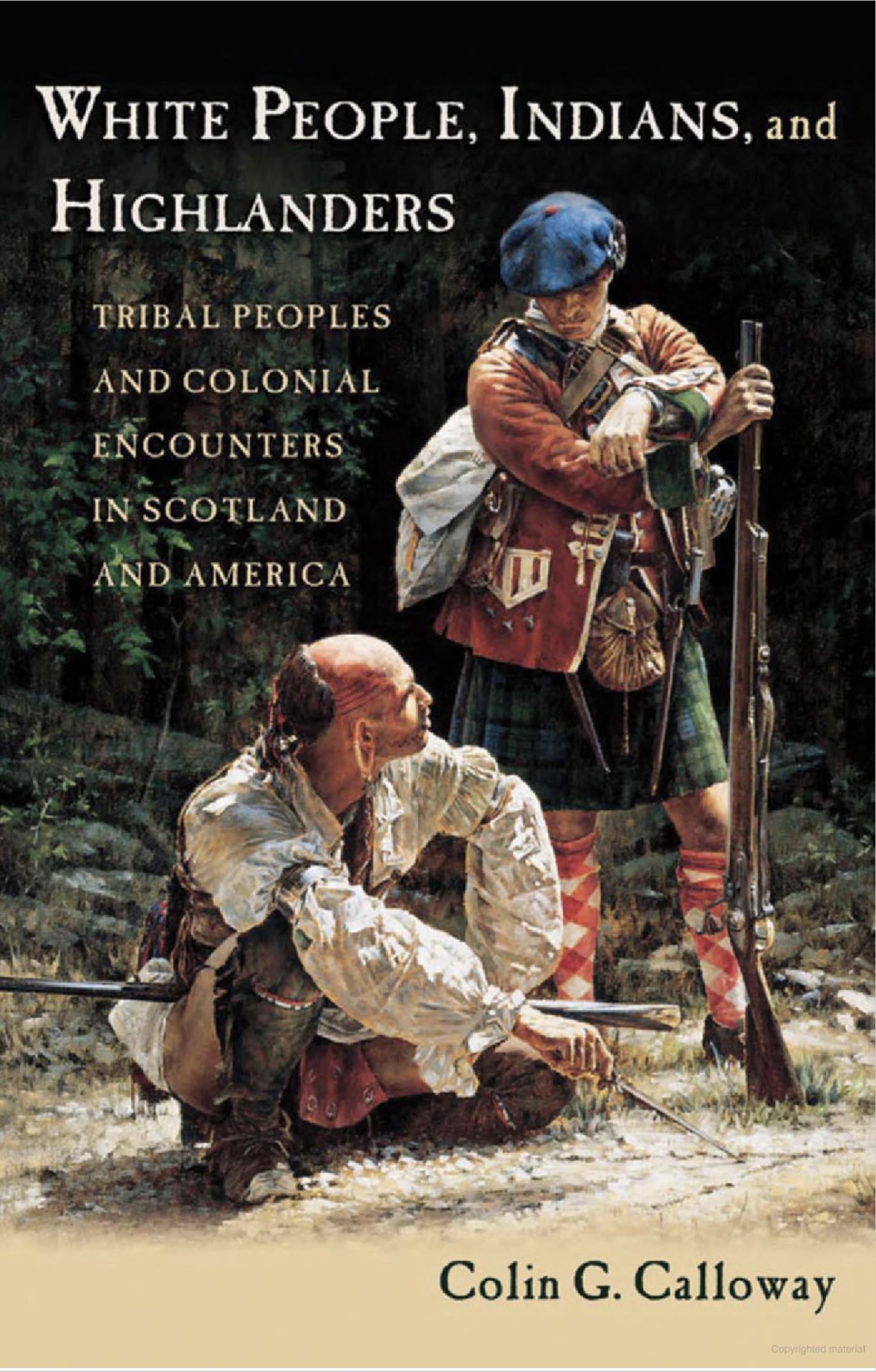
A Fascinating Set of Parallels and Intersections
First, 1779…


It might be a mistake to read these people as completely miserable. An important Indigenous principle is that the land provides, meaning that those who control the land have a duty to pass on what it provides. The principle was continually misunderstood in the Pacific Northwest a generation (or even three generations) later. Care is warranted not to misunderstand it here, either. This is not a defeated people. They are, however, hungry. They would be defeated soon, however, although Maclean’s anger is oddly one-sided.
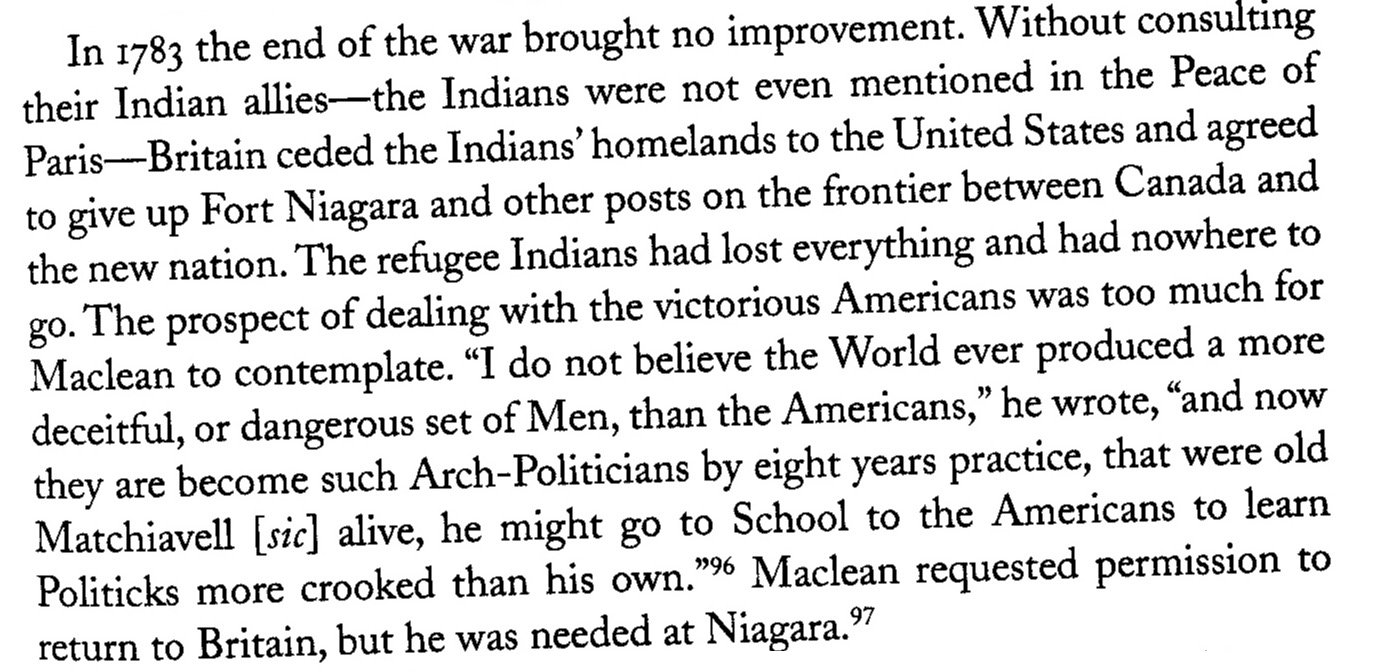
He might have swept up the British in his rage as well, but… well, let’s ask.
Harold: Wasn’t your government as guilty as the Americans?
Maclean: No.
Harold: Oh, come on. Didn’t it sign away the rights of its allies?
Maclean: That’s reality.
Harold: Obviously.
Maclean: Look, I am a military man. I follow orders.
Harold: You poor bastard
Maclean: Oh, we’re all that.
Interview with a Ghost, June 28, 2023. Transcribed by Harold Rhenisch
The Empire was overextended. As Calloway notes:

Note Maclean’s conclusion:
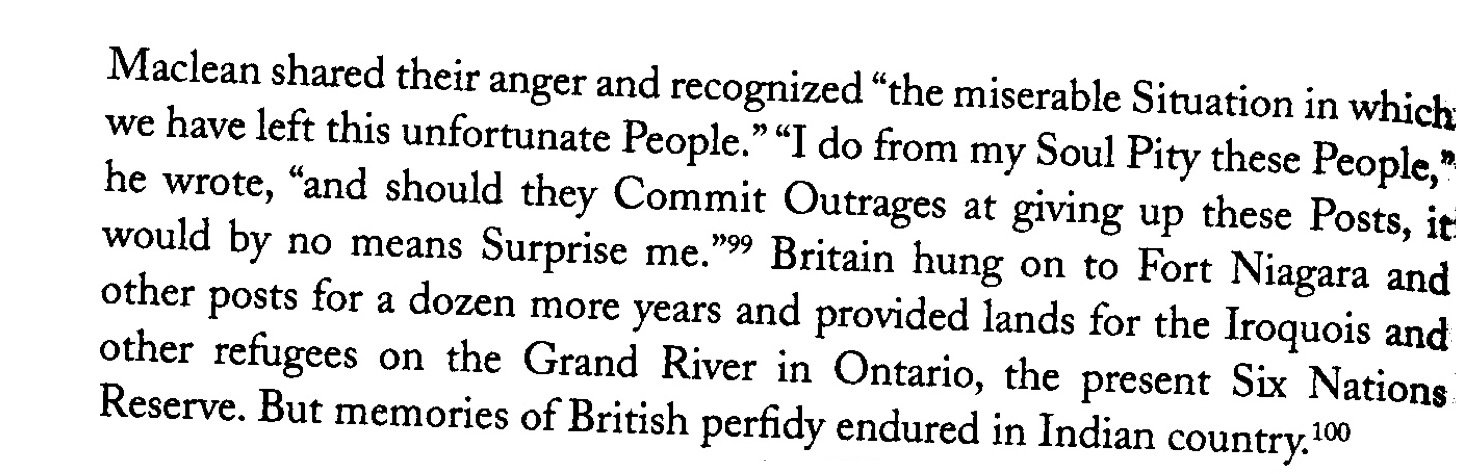
You might think I could line up a book squarely in a scanner, but (sigh) no.
Calloway’s own conclusions, are, perhaps a little more one-sided. Strictly focused on his (admirable) thesis about Highlanders being treated as wild, tribal, Indigenous people, he notes:

Sigh.
He could as well have talked about the dual stresses of the Haudenosaunee in the Rockies (and then at Pierre’s Hole.) Oh, but wait, an interruption!

The Teton Range Source
Harold: Yes?
Teton Range: You’re thinking all backwards. Do I look like Scotland?
Harold: Um… no. Why Scotland?
Teton Range: Forget Scotland. Do I look like Niagara Falls?
Harold: Well, there is a beaver dam caught in your teeth there.
Teton Range: Leave my beavers out of it! They’ve suffered enough. Besides, that’s not a fall.
Harold: No, it isn’t. So why Niagara Falls?
Teton Range: Forget Niagara Falls! And Forget the Haudenosaunee. It’s all Haudenosaunee this and Haudenosaunee that. . Come on, man. They were French.
Harold: And Haudenosaunee.
Teton Range: And French. You could at least mention that I had to put up just as much with the French displaced by the War of 1812 as the Haudenosaunee. Pierre, man. That’s French. It means rock. Like me.
Harold: Oh, yeah. Sorry.
Teton Range: Well, what are you waiting for. Get with it.
Interview with the Teton Range, June 28, 2023. Recorded by Harold Rhenisch
OK, so here’s a picture for you.
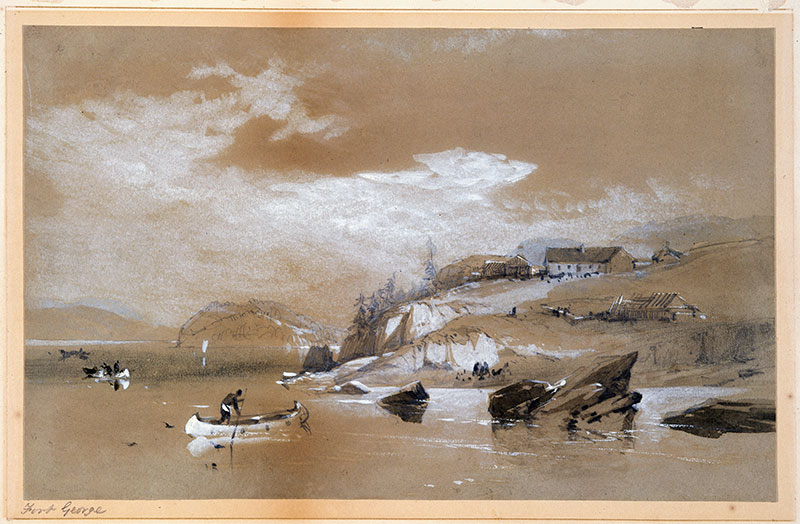
The Northwest Company’s Fort George, at the mouth of the Columbia River. Source.
The game here is:
Whose Fort Is It?
Here are the contenders:
1
The Americans
Well, a small group of them: John Jacob Astor and his Pacific Fur Company of New York. They built the fort in 1811. Few were American. The bulk were Scots, French Canadians, Hawaiians and Haudenosaunee. It was a bit of a flop and Astor transferred it to his French Canadian partners.
2
The British
When the War of 1812 started, the partners realized that they were isolated and liable to be seized a war booty by a passing British naval ship, so sold to the British, to protect their fort. By British, they meant Canadians, and by Canadians they meant themselves. Really, they liked life there and just wanted to stay and keep trapping furs. A British ship stopped by and accepted an offer of allegiance, just to make it all official-like.
3
The Tsinuk
Why not? All the land surrounding the fort was Tsinukian. What’s more, many of the men were married to Tsinuk daughters. In a matrilineal society, that made them family. It was a family business, you could say.
4
The Canadians
Again, why not. They owned it. When the Treaty of Ghent said that it had to be given back to the Americans, they sold it back to themselves as an American business. The sticking point was that little bit of theatre with the naval ship.
5
Nobody
Given how fuzzy it all was, the Treaty of 1818 gave all of the Pacific Northwest to both Britain and the United States, for them to share and not settle, for ten years. That would give them time to sort out the nuts and bolts. This proved to be too short of time and was extended.
So, on that foundation, this is what happened: Ogden started killing beavers, Gardner threatened Ogden, no-one asked native peoples a thing, the beavers were some miffed, the environment was damaged for centuries, and Pierre, caught between worlds, went to his hole…

… literally in the middle of nowhere. He was a man of the present, which is to say between worlds.
~
Next, we’ll catch up to the action at Pierre’s Hole. Because, while everyone was worrying about the past, the future showed up.
Categories: First Peoples, history, Other People, Pacific Northwest, Water



The detailed and sometimes first-hand accounts you research and offer never fail to enlighten, even as they surprise less and less. Thanks.
Regarding the “Highland Scots”: Lowland and Highland Scots – typically farmers – were victims of English expansion and colonialism, also recurring famine that came in part from their subjugation. Significant numbers would join the English Ulster-Protestant cause as soldiers in the conquest of Northern Ireland ( circa 1690 ) and do so in exchange for the promise or future hope that they could find a better fortune in the New World as proven members of the English Empire. See for one: Roxanne Dunbar-Ortiz, An Indigenous People’s History of the United States.
Note: The household cat, Felix ( German-pronunciation ) was “holed up” last night to escape the terror of American fireworks.
LikeLike