




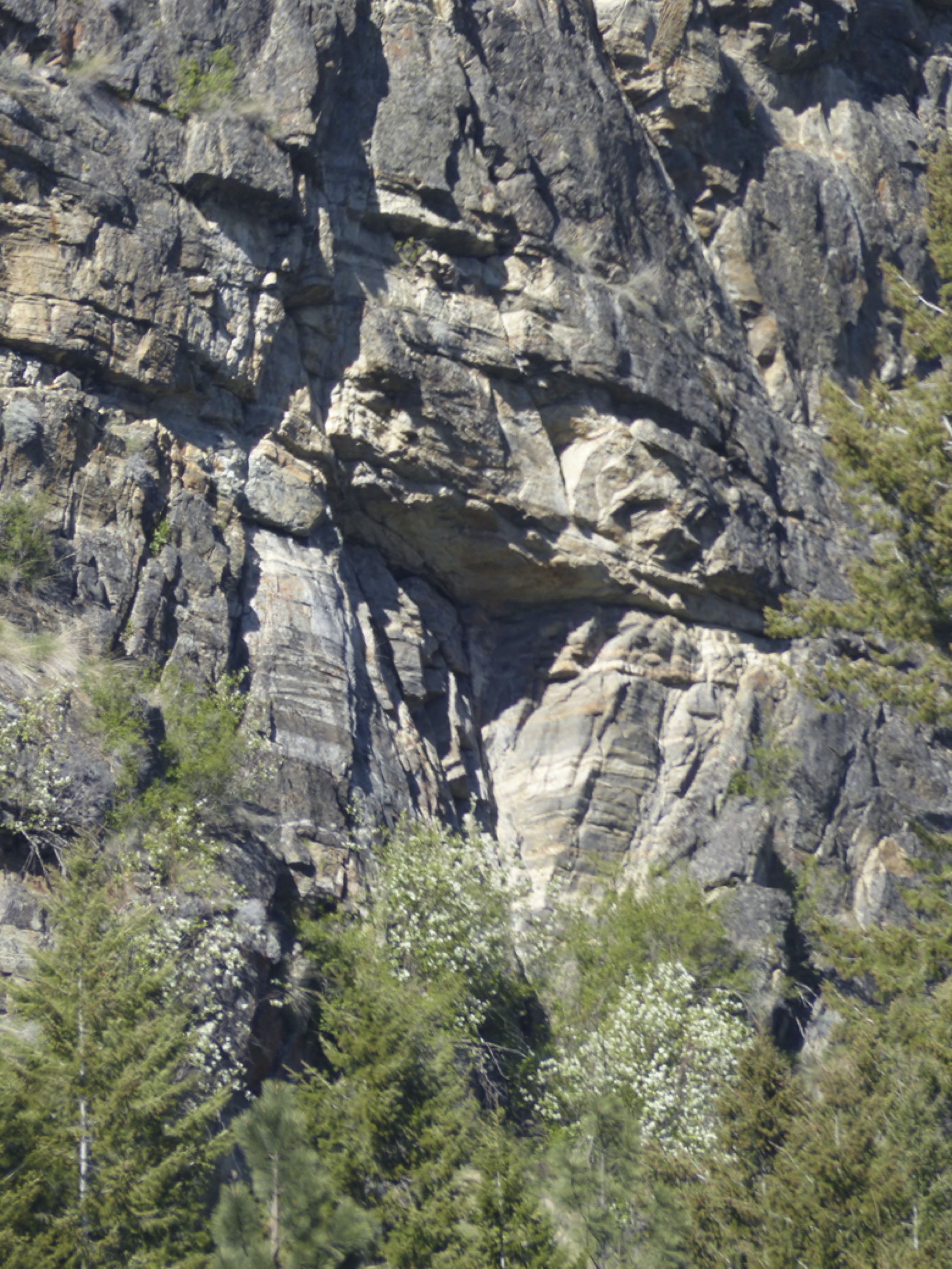
The first thing about reading stories in cliffs is that cliffs are made out of rock. What we see in them is in our own heads. Nonetheless, they allow us to see these things. Human brains are structured to see faces and human, animal or strange rock-creature shapes in such things as this cliff above Kalamalka Lake in the Okanagan Valley of Northwestern North America. Chances are you can see many of them yourself. What I’d like to demonstrate today are a couple ways of “reading” them, which I will expand on tomorrow. Here’s our cliff. What do you see? I see clowns, a lynx, men, women, a woman with a bear’s head, and much more.
The first kind of storytelling I’d like to demonstrate is what I call…
The Split
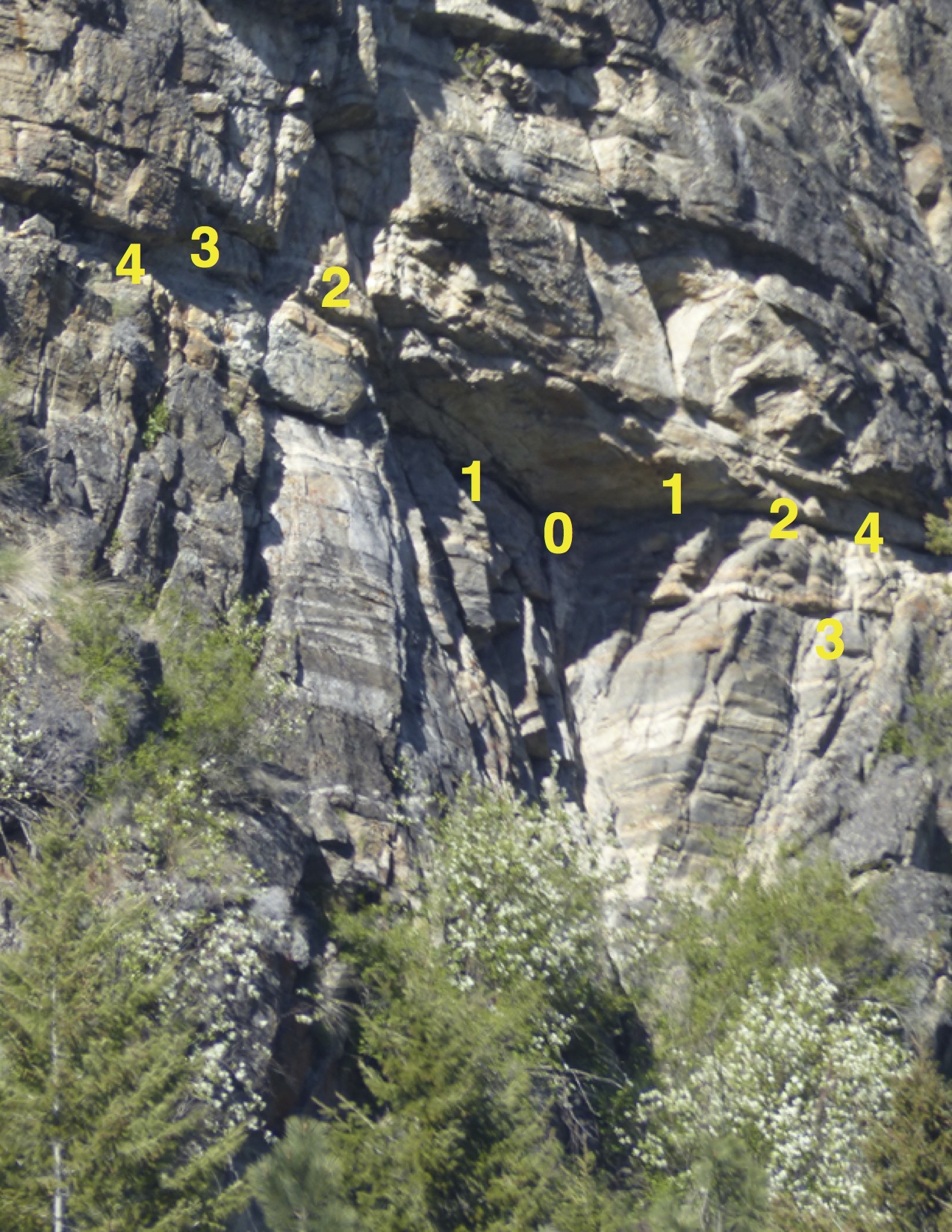
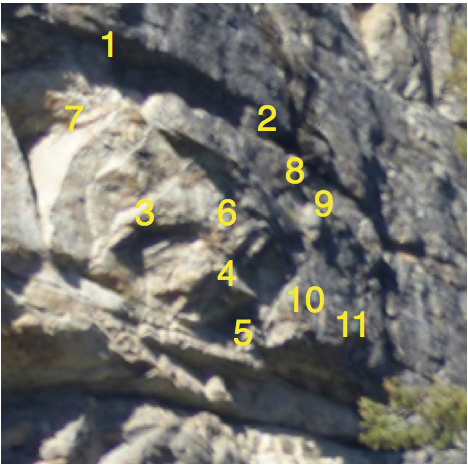
It is an energy of division and multiplication, and has, yes, a lot to do with the physical characteristics of women’s bodies and human birth: what opens and comes forth from within. This power is manifest in a few ways in the image above. First is multiplication. Here, human, or human-like, figures develop individually in a stepped sequence each way from the central point of division (0). The narrative consists of the near-musical or mathematical relationship between the variations in the creatures as they divide from the central point.
The second kind of storytelling that comes from this reading of human bodies and bodily space in rock is what I call…
Blossoming
Here, faces rise from within faces within other faces. The narrative comes from the series of transformations, just as in any proper folk tale. Here’s an example of one of the ‘faces’ from above.
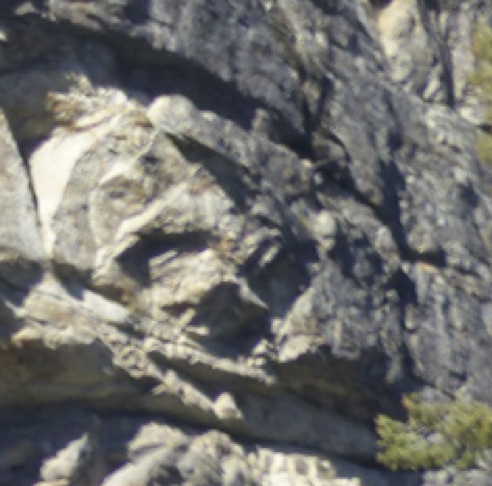
Here it is in rough outline.
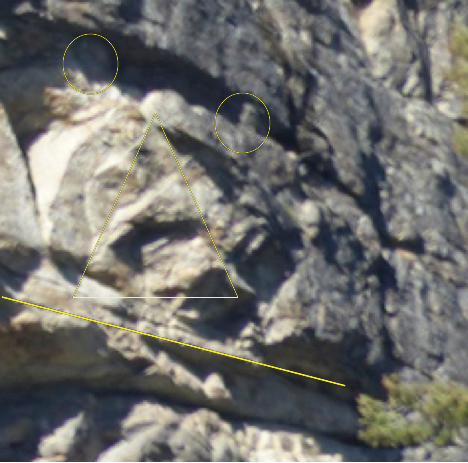
And here it is again with all the faces blossoming out of its features. It is indeed a face made out of faces. Note especially the faces that are the eyes (the upper circles above)…
A third and complementary way of reading (there are, by the way, many more than 3) has to do with relational sequence. A simple one is a phallic pole. If you wanted to call it a totem pole, to represent your ancestors, I doubt that’s any different than saying it’s a way of representing your subconscious, except that it’s read in the world rather than in the symbolic narrative abstract of an ancestral pole — an important (and closely related) difference. Here’s one:
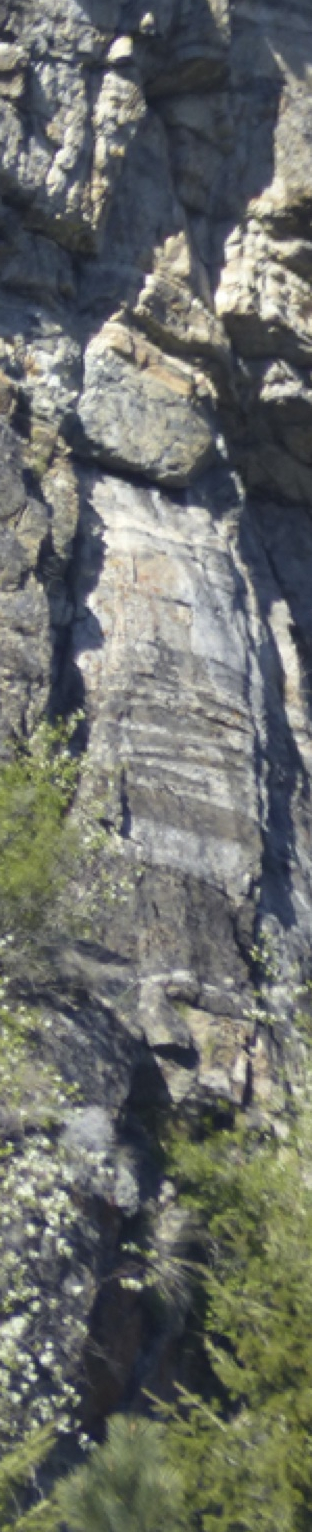
Let’s look at that again…
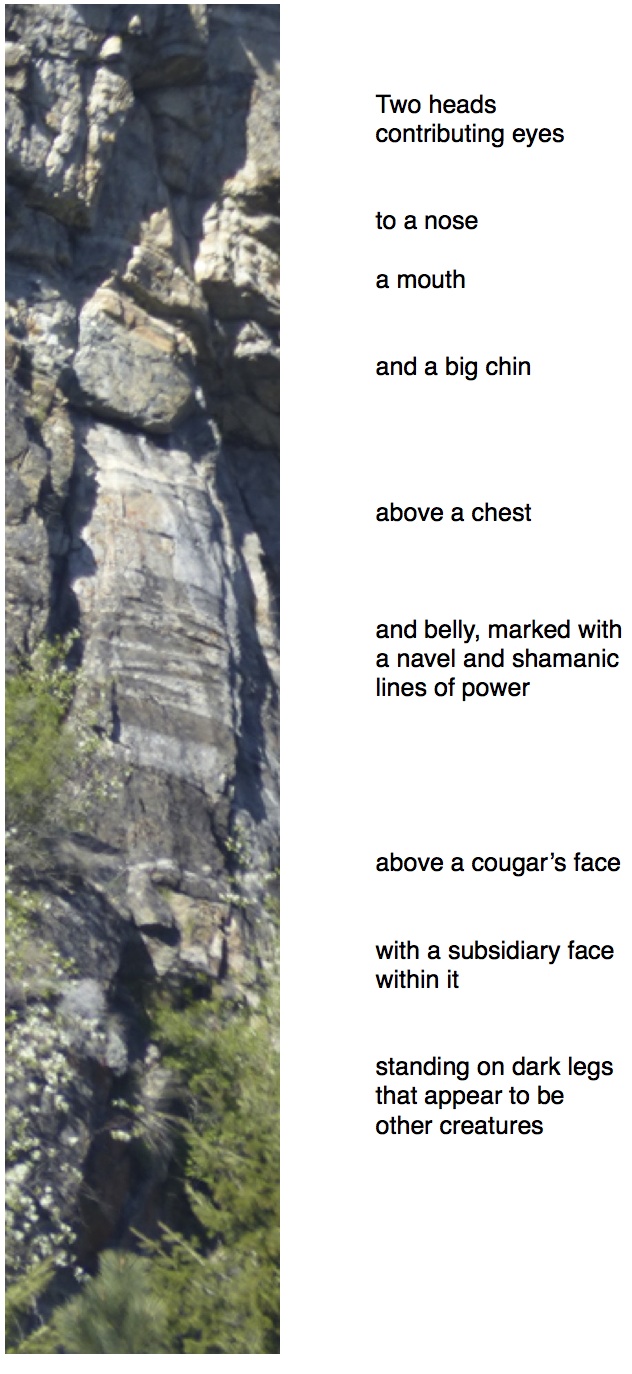
That’s a form of narrative: form rising from form and staring out like a man. Intriguingly, Syilx culture, the culture indigenous to this place, views all life as interconnected, and all life forms equal, with human responsibilities being those of maintaining this balance. Remember, though: this is not a description of Syilx culture or of some kind of magical powers within the rock. However, if you read the rock in this way you will become of this place, because you have written yourself upon it, and there you, inescapably are: a mountain you must care for. The effect could become very powerful if reinforced by stories. And that’s what we’re going to look at next time here on Okanagan Okanogan: linear narratives. Story-telling, in other words. I am working from the premise that a people who came here 10,000 years ago, without traditions of science, would have seen this landscape for the first time, in keeping with shamanic ways of seeing rooted in bodily experience. Every ancient culture has started there. If we don’t get to that tomorrow, too, we’ll get to it the next day!
Categories: First Peoples, Nature Photography, Other People, Spirit

 Okanagan Okanogan
This is exactly where I read my stories, nature. Love your story and would change immediatelly this bus driving me to my office right now for rock reading…
LikeLike
I wish you had the the power to change busses like that!
LikeLiked by 1 person