



A petroglyph site on the Snake River south of Asotin, called “Buffalo Eddy” because of the dominant figure below, speaks to the river day and night. The figure appears nowhere else and has a body shape reminiscent of a bison. Hence the name.
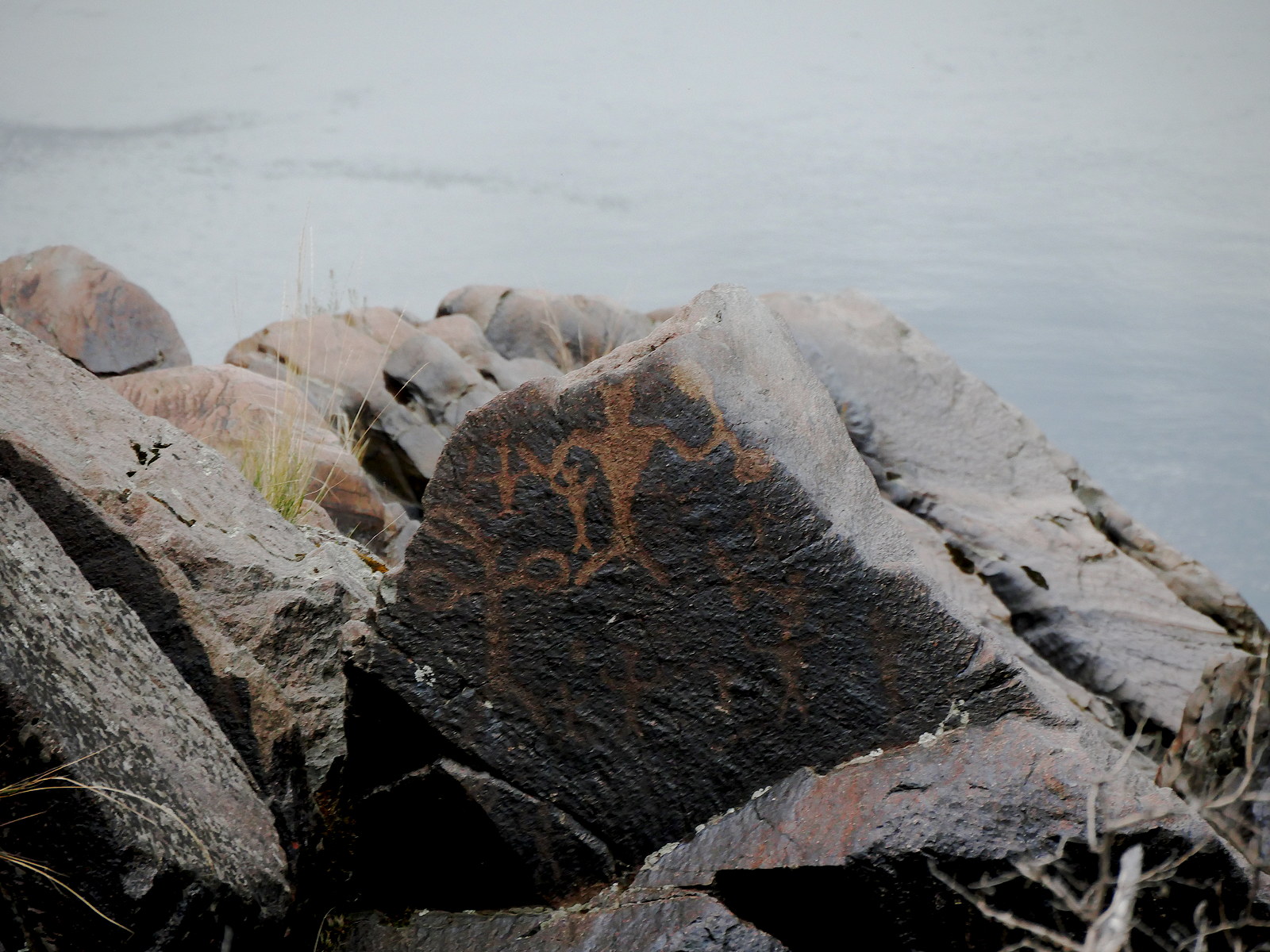
Mind you, it’s not the only figure on this panel. The one to the left (with three ovals in place of a human head and arms) is its equal. It is also suggestively human in shape. In other words, we could have called this site “Eddy of the Woman With Three Mouths”, or “Hoop Woman Eddy,” or “Three-Mouth Eddy” or “Eddy of the Spotted Lizard.” At least “eddy” is clear. The river does deepen and slow here. Now, look below, at another panel. Here the basic forms of the two figures are combined (on the right), although without the triangular body.

There is also a lizard (lower right), just as there was a bird form in the upper left of the panel in the first image (repeated below so you can look again):
Note as well, that there is a ring of people, all with different relationships to a solid circle and none necessarily human. Is that ring of people not a circle made of individual points? Does it not parallel the ring we saw in the hand of the figure in previous image? (It’s to the right in the image…look below.)
Is that relationship between a ring of people and a circular form, perhaps the moons of a year, not a dance of mind and body together? Just as the first image was, in which people were the points, materialized? Note as well the modern graffiti of name and initial, the marks of an individual-based culture that failed to read the land here. There are other circles, too, of lichen, and others that might be human made or might be made by lichens. There might be a conversation between the two. It wouldn’t counter the principles of sympathetic magic, which a literate culture might call metaphor. Plus, there’s this figure from a floor stone further on, perhaps a stain of red rock on the rock face, or maybe one altered by human intervention.

I’m not sure it matters whether rock and river made it or a human hand and eye, or both together. There’s also the goat below, which does clearly appear to have been chipped out of an extruded volcanic layer. If it is a goat. Or maybe a sheep. Or a deer. Is it modern graffiti again? If so, it is a violent and simplistic reading.

Society is oriented around individuals today and a clear demarcation between species. In this world view, humans are people. Stone is not. For example, the point of the petroglyph site below is not generally seen as a person today:

It is, however, still a body. Humans who read writing in stone and then repeated it just as humans today repeat scripts on stage and screen or texts in books, were modern individuals at the time. They remain present in the marks, which are only slowly taken away by the river and lichen. There’s no reason not to read both of these impulses together, with humans reading themselves in rock at the same time that they write stories upon it. The rock below at the tip of the site can be read as a human artefact…
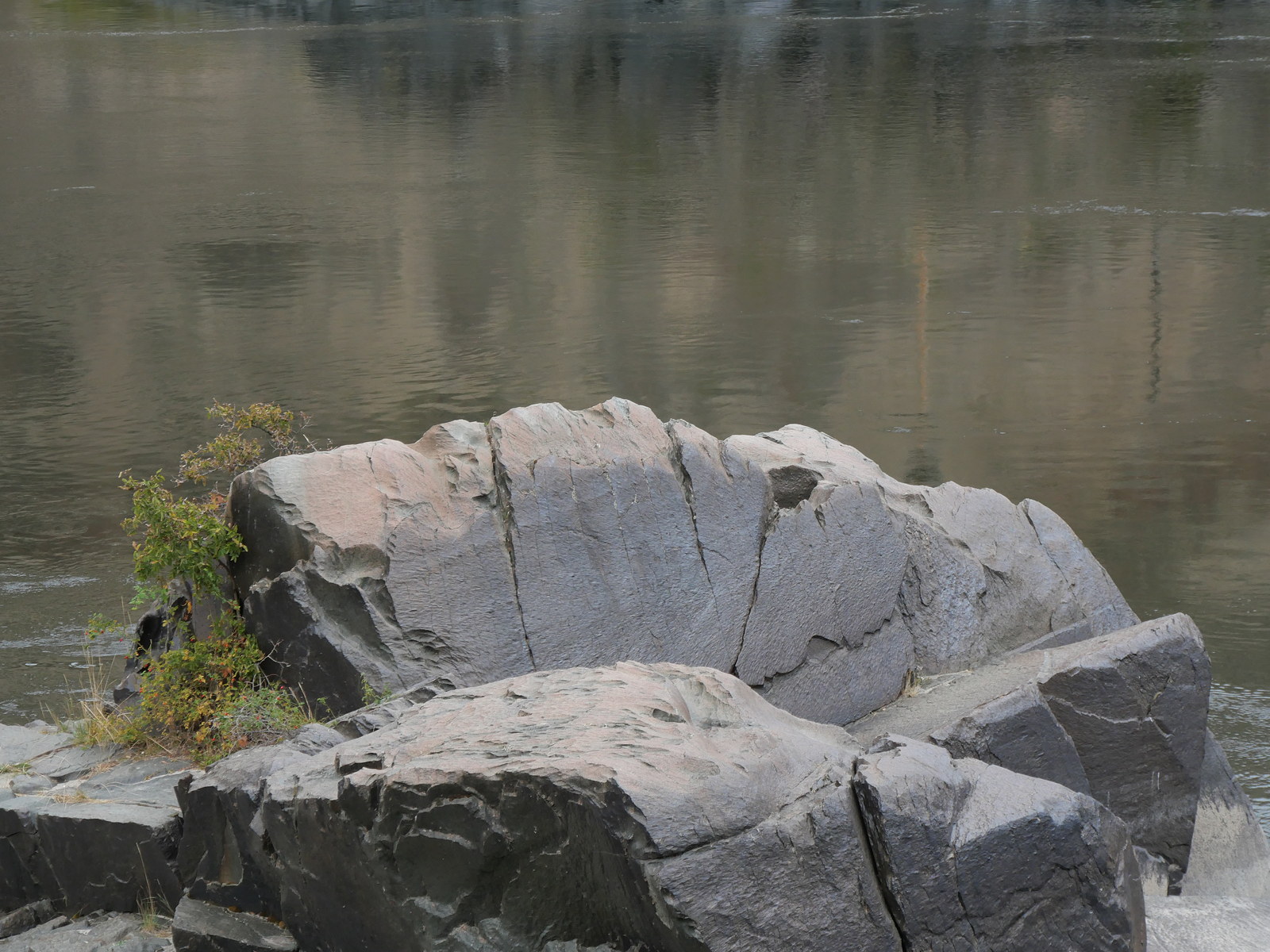
… or as an image of a body seeing itself right now. Time is not the issue. One old word for this effect is “oracle.” It still carries.
Categories: Arts, Cascadia, Earth, First Peoples, Gaia, History, Light, Nature Photography, Other People, Spirit, Water

 Okanagan Okanogan