





In the last episode of this exploration of the end of the Old West, I showed how international diplomacy and trade are poor partners. I was talking about Peter Skene Ogden’s expeditions to destroy every beaver in the Snake River Country from 1824-1826, to keep the Americans out of Cascadia.

A Stream Missing Its Beavers in the Snake River Canyon. Photo by Harold Rhenisch
It was a spectacularly narrow-minded approach. Ostensibly, the target was a loose group of independent trappers called Mountain Men, who had a habit of exploring territory (as the French had down from their primitive farms on the Saint Lawrence a couple hundred years earlier) and leading others to explore it as well. Or, as Wikipedia puts it:
A mountain man is an explorer who lives in the wilderness and makes his living from hunting and trapping. Mountain men were most common in the North American Rocky Mountains from about 1810 through to the 1880s (with a peak population in the early 1840s). They were instrumental in opening up the various emigrant trails (widened into wagon roads) allowing Americans in the east to settle the new territories of the far west by organized wagon trains traveling over roads explored and in many cases, physically improved by the mountain men and the big fur companies originally to serve the mule train-based inland fur trade.
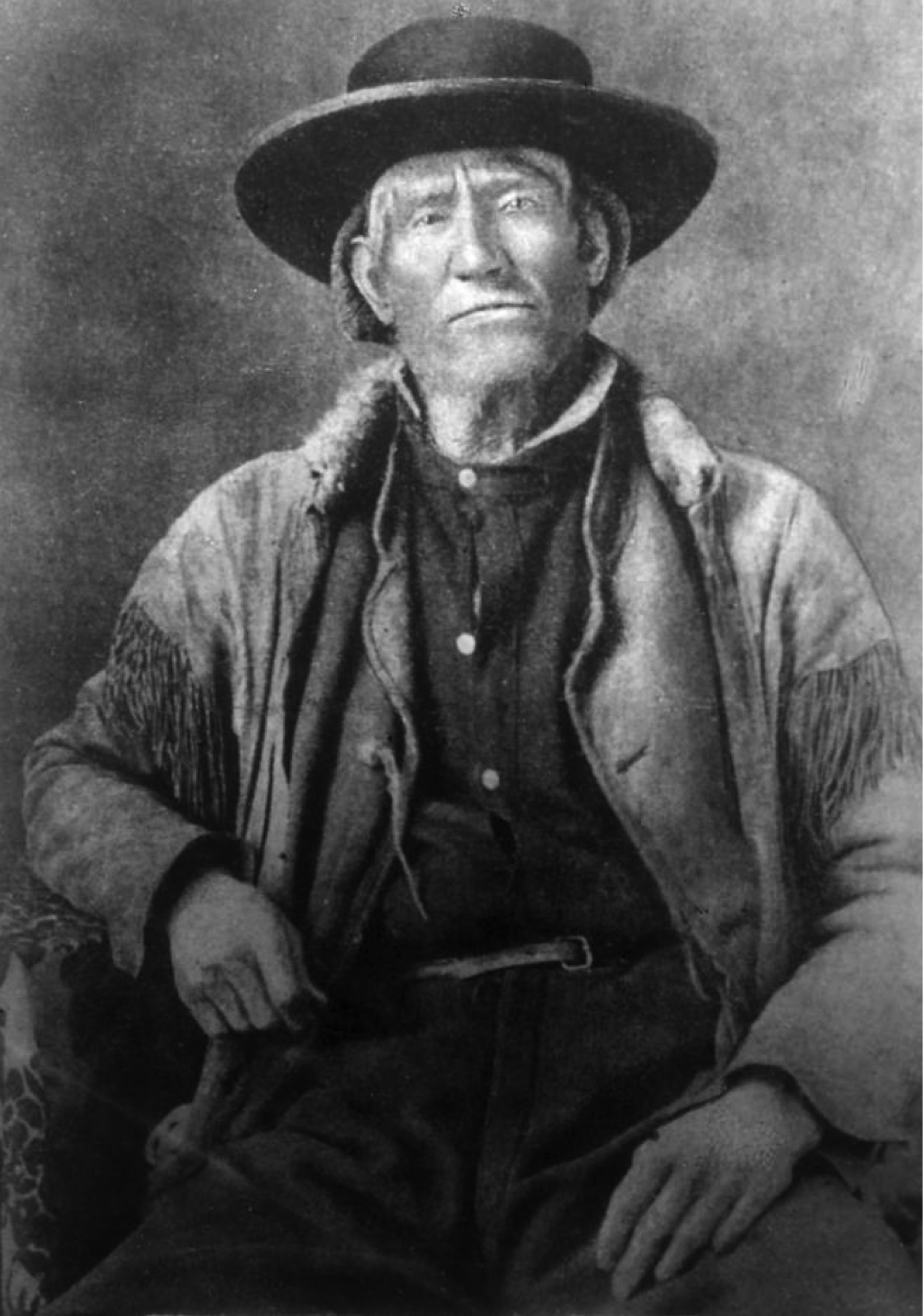
Jim Bridger, Mountain Man Source
Or maybe not so independent.
Approximately 3,000 mountain men ranged the mountains between 1820 and 1840…While there were many free trappers, most mountain men were employed by major fur companies. The life of a company man was almost militarized. The men had mess groups, hunted and trapped in brigades, and always reported to the head of the trapping party. This man was called a “boosway”, a bastardization of the French term bourgeois. He was the leader of the brigade and the head trader.
Peter Skene Ogden was a boosway. Pierre Tevanitagon, after whom Pierre’s Hole (the centre of this history) was named, was a free trapper. But it was no ordinary expedition. It might have sought to block Americans, but it placed Indigenous people in a terrible position: having become dependent on HBC goods, without beavers they were without currency and could not even buy the weapons they needed for defence.

The Barnett Trade Gun
Obsolete, but still deadly. Source.
The HBC had simply given up on the Columbia District, and if they were at risk of losing it, then they would make it worthless. It wasn’t worthless, of course, but that’s another problem of getting a mercantile business to fight your wars for you. Ironically, it is now an American company.

What the HBC is trading these days.
The headlessness is weird, but that’s the way the company wants it.
On the American side, though, I suspect that having the mountain men as a target for HBC’s ecocidal expedition contains more than a little bit of American myth-making:
the independent explorer living off the land, fighting his own way through hostile Indian territory, and expanding US territory by guts and pluck and administering justice by his illiberal use of the 2nd Amendment to the US Constitution:
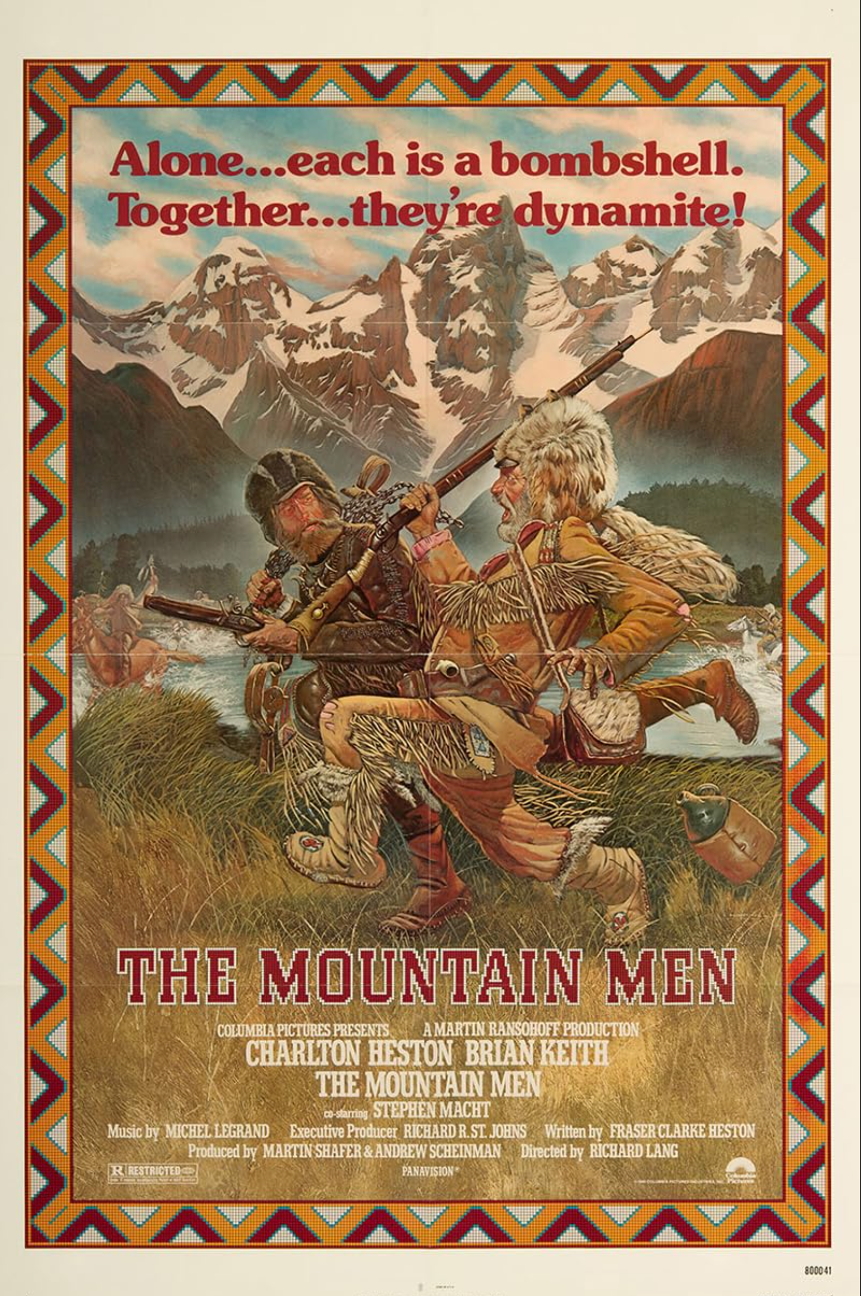
Yes, myth-making. Here’s the plot:
Bill Tyler is an argumentative, curmudgeonly mountain man. Henry Frapp is Tyler’s good friend and fellow trapper.…Tyler looks for a legendary valley, in Blackfoot territory, “so full of beaver that they just jump in the traps.” Running Moon leaves her abusive husband, a ruthless Blackfoot warrior named Heavy Eagle, and comes across the two trappers in the dying days of the fur trapping era. While at first Bill only wants to take her to safety at the rendezvous, she refuses to leave and eventually becomes his woman. While trapping, Bill and Henry are attacked by Blackfeet and Henry is scalped by Heavy Eagle in front of Bill. Tyler runs back to camp and he and Running Moon flee only to be caught. Later, Tyler (thinking Running Moon has also been killed) is given a chance to run for his life (similar to the real life event of John Colter) and is chased by warriors whom he initially eludes by hiding in a beaver den. They pursue him until he and Heavy Eagle fall into a raging river. Heavy Eagle makes it to shore and Bill goes over a waterfall. Heavy Eagle returns to his camp and tries to make Running Moon his woman again, raping her, but she refuses to submit to him. He knows Bill Tyler survived and will come for her, just as he had done. And that’s just the first half. You can read the rest of this nonsense here:
And that’s just the first half. You can read the rest of this nonsense here.
So, yeah, it’s more likely that the target was this guy:

Jebediah Smith. Source.
He was killed by Indigenous people in New Mexico in 1831. Most mountain men met a violent death, because their work was actually war. Before that, though, Smith played an important role in brokering the US migration to Oregon by discovering the South Pass across the mountains, as a partner in The Rocky Mountain Fur Company,
“established in St. Louis, Missouri, in 1822 by William Henry Ashley and Andrew Henry. Among the original employees, known as “Ashley’s Hundred,” were Jedediah Smith, who went on to take a leading role in the company’s operations, and Jim Bridger, who was among those who bought out Smith and his partners in 1830. It was Bridger and his partners who gave the enterprise the name “Rocky Mountain Fur Company.”
Smith and his early partners started the Brigade system in the US, copying the Northwest Company’s approach. Ogden’s role was to challenge them, and always to keep his eye on this guy:
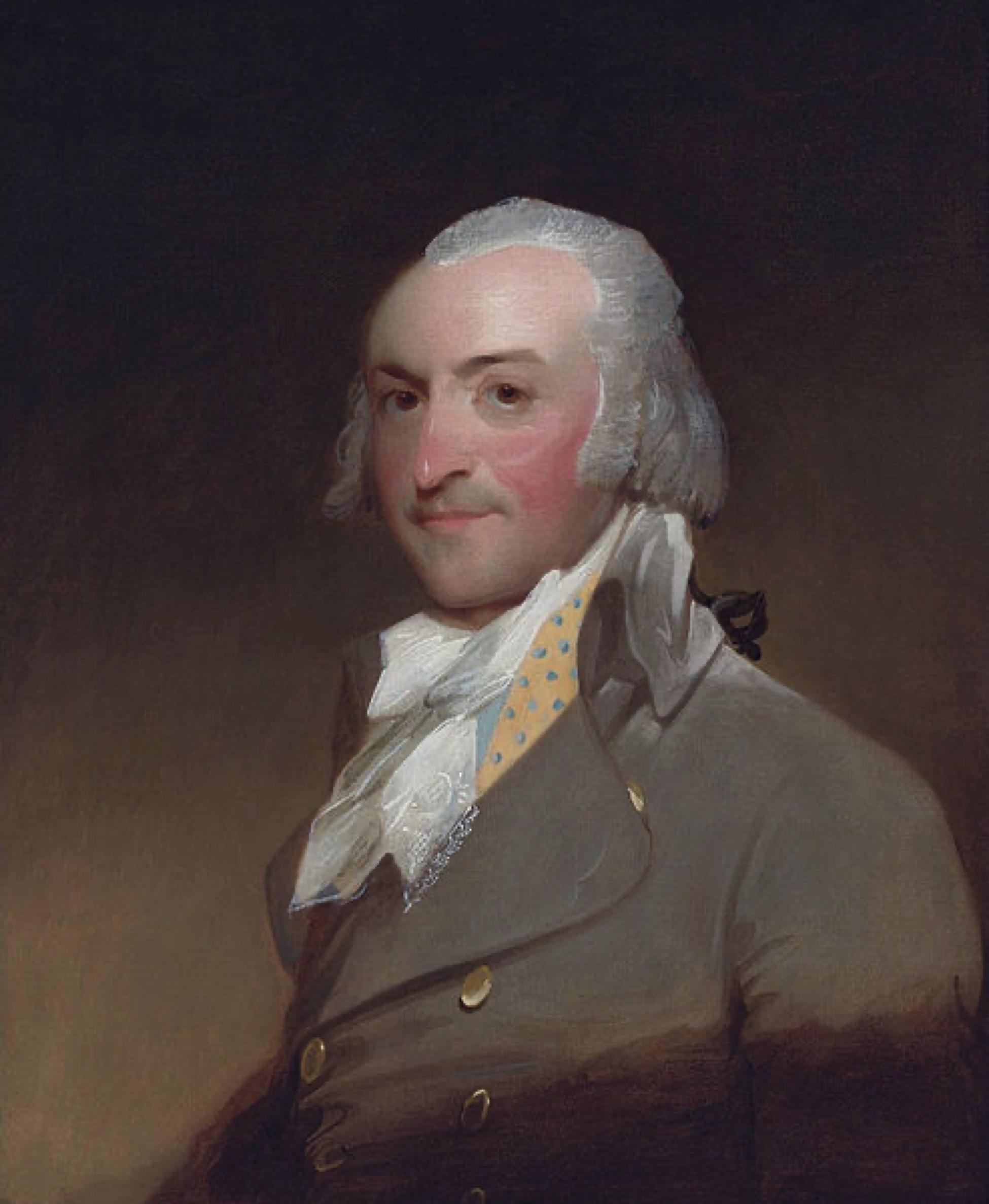
John Jacob Astor in 1794, by Gilbert Stuart. Source.
In 1808, Astor, a German-American, started the American Fur Company in New York. His goal was to create a cross-continental trade system built around a chain of linked forts, all long after the Russians did the same in Siberia (reaching all the way to Alaska) and long before the USA became a continental country and even longer before Amazon took it over.
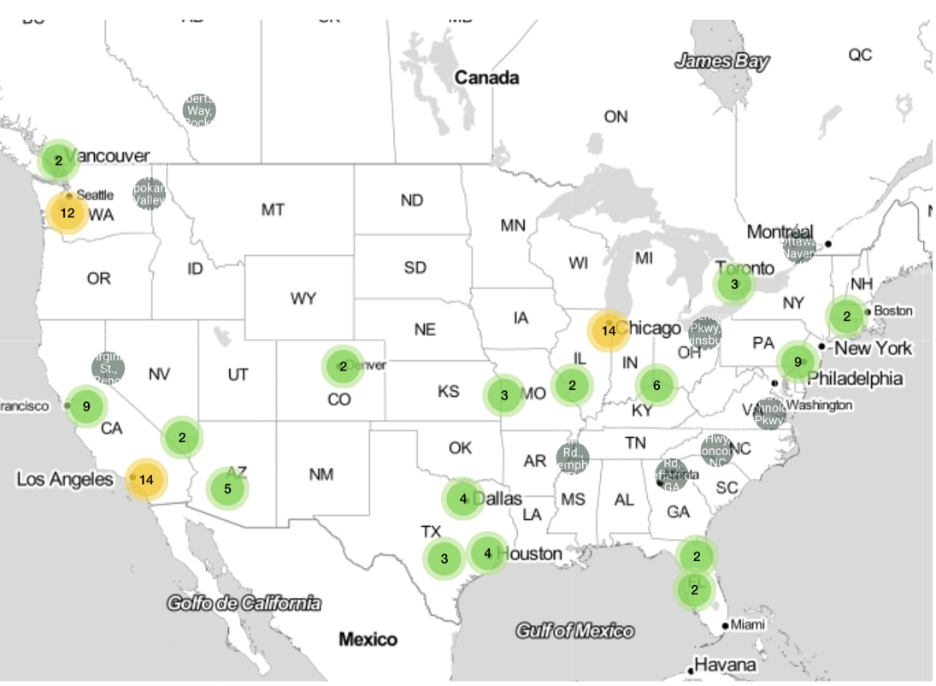
Astor Had the Plan, but Amazon Had the Fulfillment
Amazon’s linked trading warehouses.
If you asked yourself…
You: Hmmm, doesn’t the HBC’s strategy sound a wee bit political?
…you’d have no-one to ask, except maybe an old friend, and he might say:
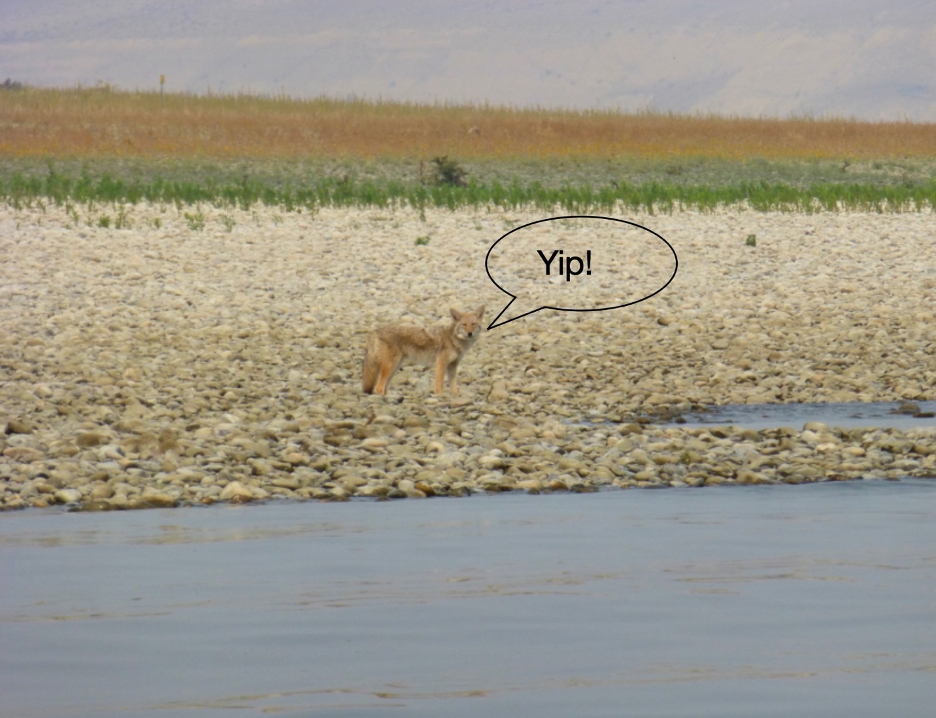
A Coyote Checking Radiation Levels at Hanford Reach. Photo by Harold Rhenisch.
And Koyoti would be right. Astor’s first move was to secure presidential support. When that didn’t come, he plunged in on his own by creating a subsidiary: The Pacific Fur Company. This is the company that erected Fort Astoria, at the mouth of the Columbia River, in 1811…

Fort Astoria in 1813, sketch by Gabriel Franchère
…getting the first beams up just days before the Northwest Company’s David Thompson arrived to claim the location for the British. You can read this story here.

Gabriel Franchére’s Montreal in 1812, with Kahnawake across the river. Painting by Thomas Davies. Source.
It’s from here that the Northwest Company left for the west. Canoe expeditions were outfitted with French and Iroquois men from here. Ironically, so were the expeditions of the American Fur Company.
Koyoti: See? This is the kind of thing that looks a lot like ritual behaviour between Europeans, man.
Harold: Well, now that you mention it, yeah.
Koyoti: I mean, did Astor ask me?
Harold: I’m guessing not.
Koyoti: And you’d be right. That’s rude, that’s what it is. You gotta ask.
Harold: Ah. So, what should I ask, then?
Koyoti: Just if one week’s difference in arrival after 16,000+ years of human occupation really makes a case for ownership.
Harold: Is ownership of land even a possibility?
Koyoti: You tell me.
Harold: Well, what’s this?
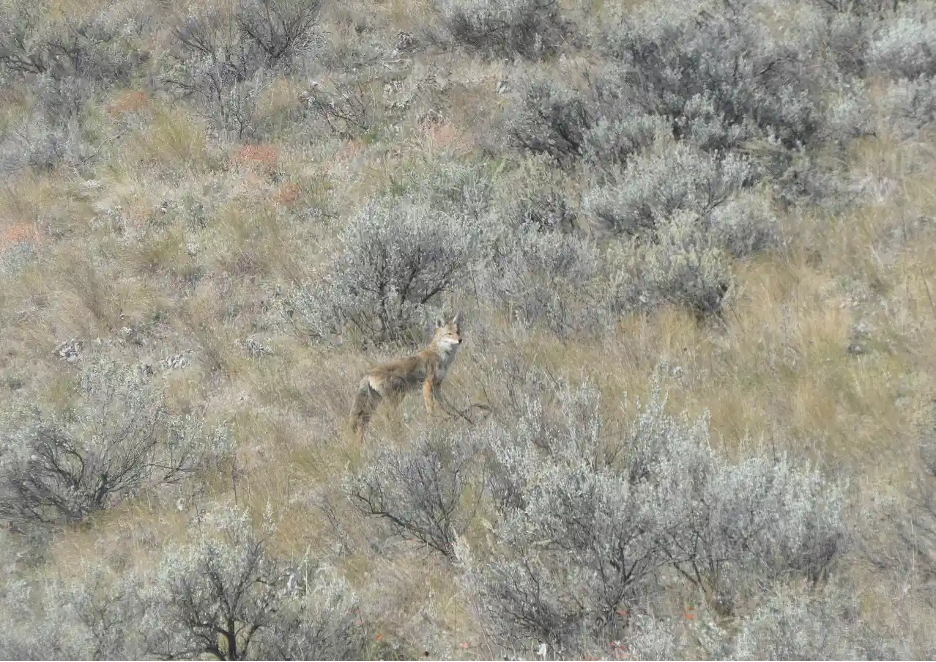
A Coyote Above Canim Bay. Photo by Harold Rhenisch.
Koyoti: Belonging.
Harold: Ah. Belonging or not, the Treaty of Ghent was followed by the Treaty of 1818, which gave both the Americans and the British temporary shared control of Cascadia, with the caveat that settlement was out of the question until “ownership” was determined.
Koyoti: You mean, among the courtly rituals of European states but not the rituals of the land. Ownership was already determined.
Here’s what the Treaty of 1818 says:
It is agreed, that any Country that may be claimed by either Party on the North West Coast of America, Westward of the Stony Mountains, shall, together with its Harbours, Bays, and Creeks, and the Navigation of all Rivers within the same, be free and open, for the term of ten Years from the date of the Signature of the present Convention, to the Vessels, Citizens, and Subjects of the Two Powers: it being well understood, that this Agreement is not to be construed to the Prejudice of any Claim, which either of the Two High Contracting Parties may have to any part of the said Country, nor shall it be taken to affect the Claims of any other Power or State to any part of the said Country; the only Object of The High Contracting Parties, in that respect, being to prevent disputes and differences amongst Themselves. Source.
Harold: That does sound a tad ritualistic.
Koyoti: Sure does Just like this:

Photo by Harold Rhenisch.
Harold: What is that?
Koyoti: A ritual wall. Wishram cultire. Get teenagers to build them. Keep them out of trouble, you know.
Harold: But for what purpose?
Koyoti: Nothing. That’s the purpose. They’re teenagers. It’s a ritual. Duh.
Harold: Ah.
Pressures mounted. Because the British could no longer trade out of Montreal into Louisiana, formerly a major part of the company’s trading region, it was forced into harsher competition with the Hudson’s Bay Company to the North. Instead of heading west from Fort William on Lake Superior or from Green Bay on Lake Michigan, as the French had…
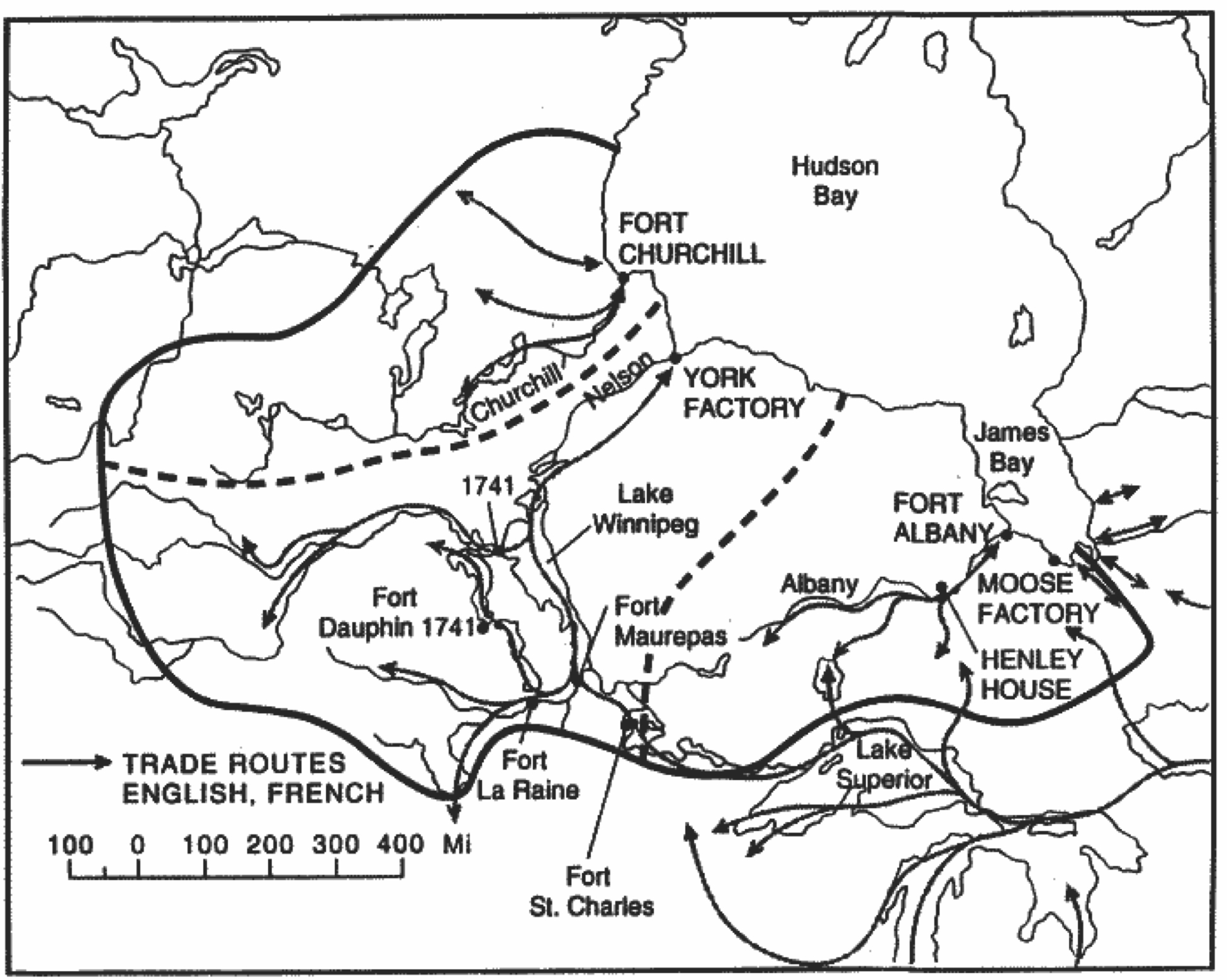
… or simply out of southern Assiniboia and up the Missouri, on old French routes now used by the Americans…

Trade Routes in Today’s South Dakota
…they had to go the long way…

Far Far to the North
Blue: Northwest Company.
Red: HBC.
All the watersheds along the North Saskatchewan and Assinboia Rivers traditionally traded with the HBC territory. Indigenous trading parties were used to spending a year paddling to Hudson’s Bay to trade. Once there were two companies trading in the same area, things became tense. The furs that the Northwest Company’s were taking were ones that would have once been delivered to Hudson’s Bay or were coming from new territories that the HBC also needed to survive. After all, this was a trade that decimated beavers and had to keep finding new territories. The solution? The HBC moved forts onto the plains, far from Hudson’s Bay. Right into direct conflict with the Northwest Company, that had been forced to move north.
One of the enforcers in the ensuing war of sabotage and murder was Peter Skene Ogden.

Ogden in 1848. Source.
Here are some details on his murderous youth. I will add here that Ogden came from a United Empire Loyalist family driven out of the US by the American Revolution, who had settled in the Eastern Townships of Quebec. His allegiances weren’t to the French, nor theirs to him, although he did speak French, in a very Anglo kind of way.
At this point, a little bad planning in the setup of Assiniboia came into play: it was set up on a Métis camp, and they weren’t about to leave. Soon, they were breaking a HBC monopoly on trade by selling pemmican to the Northwest Company, as the free people that they were. Like the Iroquois, they bridged cultures. So, there was a war about that, aptly called The Pemmican War.
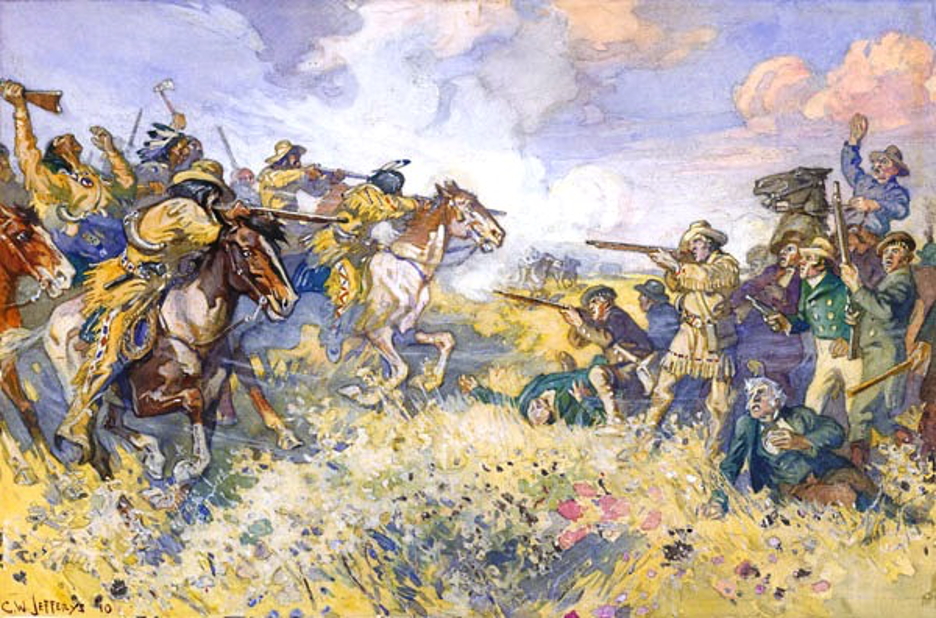
The Pemmican War’s Battle of Seven Oaks.Source.
The violence resulting from the clash of interests in a declining beaver population led to a forced merger of the companies in 1821, lest they destroy the fur trade altogether. Ah, who’s this?

Photo by Harold Rhenisch
Harold: Oh, Hi, Stunx.
Stunx: Go away.

Photo by Harold Rhenisch
Harold: A little touchy, are we?
Beaver: Fur trade? Who needs a fur trade? How’d you like to be turned into felt and pressed into a hat?
Harold: Well, maybe it wasn’t about furs.
Beaver: Go on…

Photo by Harold Rhenisch
Harold: Maybe it was the old problem of a company started by a king to circumvent parliament and have a foreign colony without committing a rebellious and tedious parliament to it, given that parliament had murdered the previous king?
Beaver: You mean the Hudson’s Bay Company.
Harold: Yes, letting merchants stand in for an army means you will have an army of merchants.
Beaver: Hat merchants.
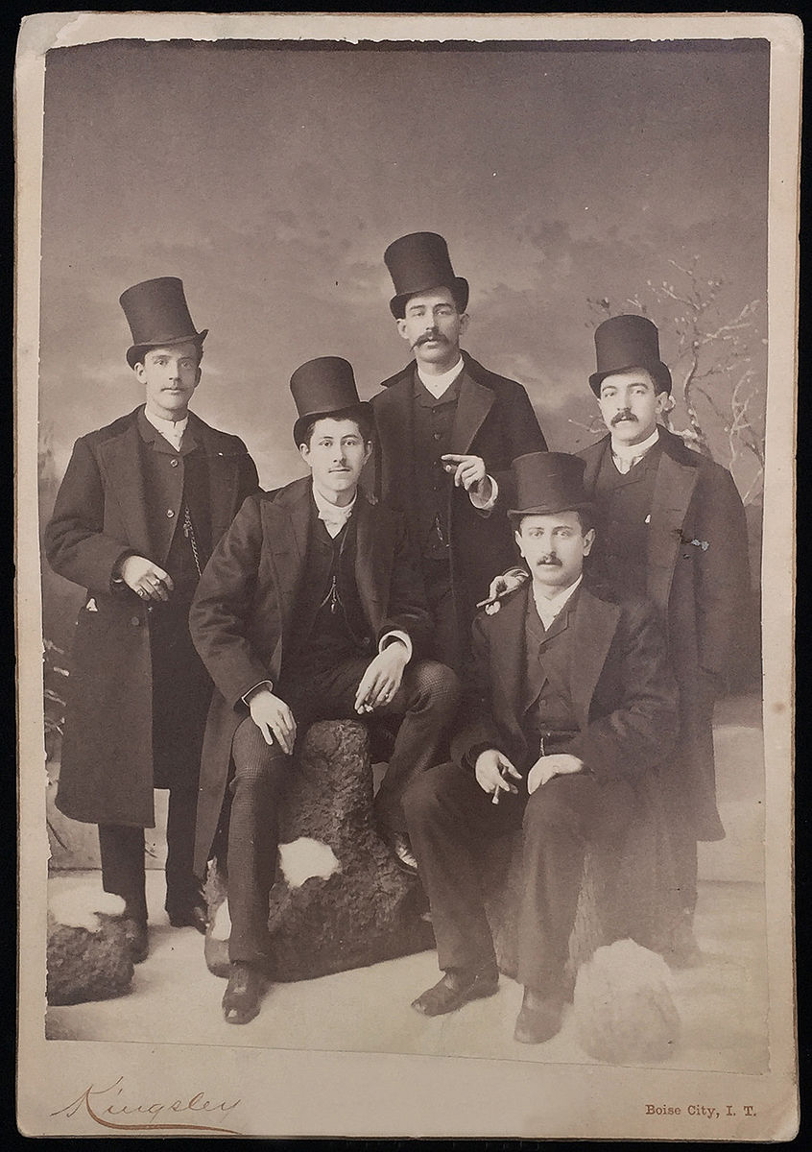
The Gentlemen of Boise Idaho in their Beaver Hats c. 1866. Source.
Harold: Yes. The problem is, if you’re going to rule by mercantile trade, you are vulnerable to competition.
Stunx: And traps, man.
Harold: Right, and traps.
Expeditions like Ogden’s were dangerous. The killing of Indigenous ancestors…

Stunx, the Water Keeper. A Top-Notch Ancestor. Photo by Harold Rhenisch
… without the permission of their relatives, the Shoshones, the Bannocks, the Utes, the Nimiípu’u and many others down into New Spain meant that the land the expedition entered, not to mention the land the American traders entered from the East, was fought for by local people, who saw the goods and horses of the expeditions as more profitable to them than their already nearly-extirpated beavers, which they didn’t particularly want to go hunting for in the cold, anyway.
Next: The Iroquois go on strike. See you on the line.
Categories: Ethics, First Peoples, history, Industry, Pacific Northwest

 Okanagan Okanogan


