




 Apple Orchard at Fort Okanogan
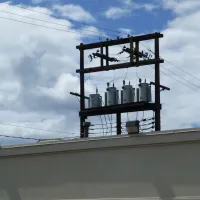
I’d like to introduce you to two of the players in the game being played right now for the heart of the valley. Above, at the mouth of the Okanogan River, across the road from Fort Okanogan, the first European settlement in the Interior, an apple plantation has been placed within a grassland of black sage, yarrow, and rabbitbrush (and a lot of European weeds) as if it were a colony on Mars. Just a few miles upriver, the Chief Joseph Dam ends the chance of any salmon swimming farther to the north and east. Just a few miles downriver, nine mothballed nuclear reactors are sitting on the banks of the river as the wind whistles between them. Let’s call this the “cowboy” side of the table. They’re keeping a pretty straight face. On the other side of the table, also with what looks like a pretty good hand…
 Senkulmen Business Park
…in the black sage and bunchgrass (and a lot of European weeds) at Gallagher Lake, the Osoyoos Indian Band has been hard at work developing an industrial park, as a foundation for future income and growth. The two ceremonial figures hold up rings from a hoop dance, which look a lot like a model of an atom and its electrons, painted in the four sacred ceremonial colours of the Plateau. Although this might be the “indian” side of the table, whoever’s sitting at it has his eyes on the big picture.
What’s the big picture? Is it the fast flux test facility in the desert? Is it the fact that an American game, poker, with its film set players are sitting at a game for the land, as if the border wasn’t there? Is it that this game, played in the open for high stakes, goes unnoticed? Is it that the “Canadians” don’t seem to be at the table? Is it that the cowboys and indians are really one culture? Answers tomorrow.
Categories: Agriculture, Industry, Land

 Okanagan Okanogan