




Well, yes, it is. You can see the flood basalts here in the Grand Coulee, the thin pours of lava that made the Columbia Plateau, and you can see the result of them being sliced up by melting glaciers (they were south of the glaciers themselves)…

Lake Lenore Cliffs, photo by Harold Rhenisch
…but you also see a language that is not geological. The scree slopes tumbling down from the basalt cliffs are not slopes so much as blockages, barring human movement, yet they are separated by a gap made by the harder cliff between them. What you are looking at is body, thrust and intent, that creates an invitation. If you are going to approach the cliff, body to body, it will be there. Art is quite able to accept the invitation and respond to it, as it does even in the simple photograph above, but if the Earth’s body and ours are to be united in a way that preserves geology, then such gaps and invitations within the mind will need to be studied, too. Perhaps this image of the next cliff to the south, right at the northern lip of Lake Lenore, can illustrate what is at play there. Notice the yellow road sign at the base of the cliff, left of centre. It is doing a couple of things.

Lake Lenore Cliffs, photo by Harold Rhenisch
First, it is removing the cliff from nature and setting it into 21st socio-political life. Second, its very presence demonstrates that the premier value in this (U.S.) culture is movement and transportation. It is often called a settler culture, but that’s a misnomer. It’s not settled at all. It is only passing through and marking the land, even rewriting it, with its trails. A settled culture would do no such thing. It would not need a sign.
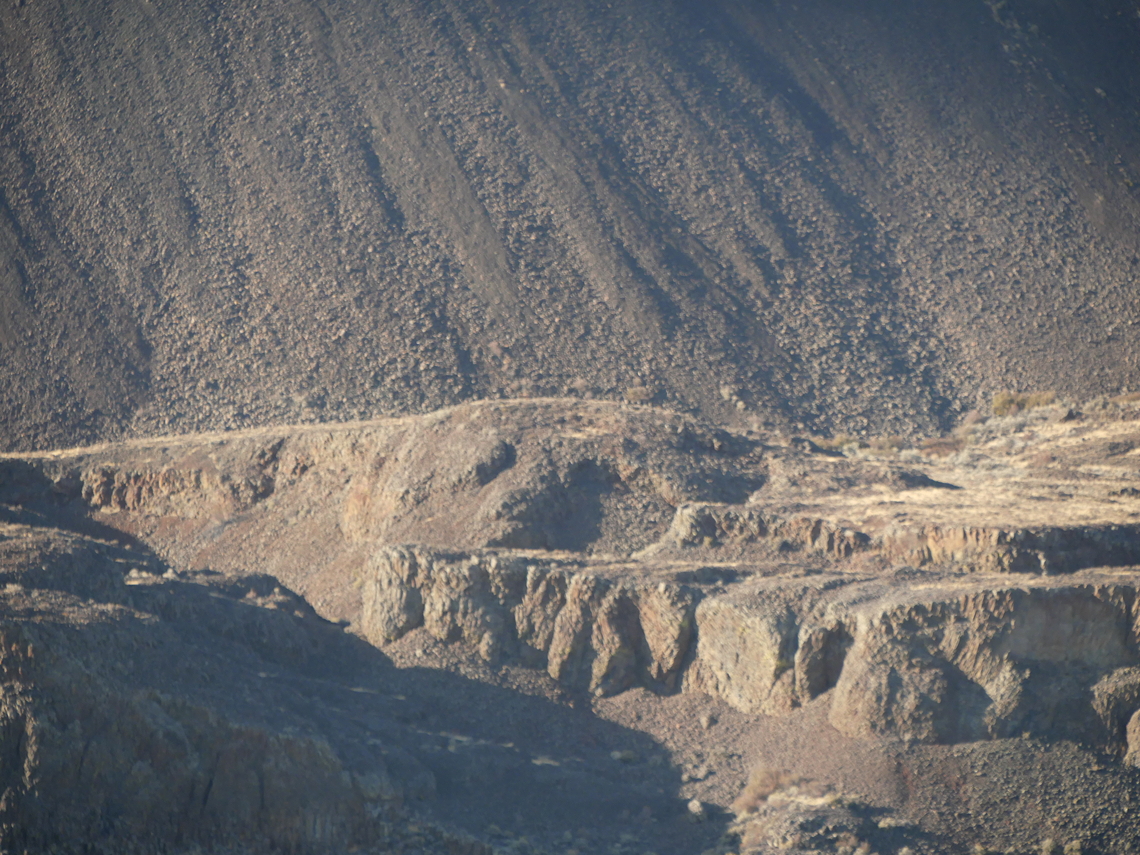
Lake Lenore Cliffs, photo by Harold Rhenisch
It would be the sign, as the next cliff still is, or, actually a whole book of signs on one page, needing no explanation, because they are not for the mind. They are for the body, and the mind, being sensible, follows.
Categories: Nature Photography

 Okanagan Okanogan