


In this final visit to Pierre’s Hole, I hope to show how Sioux (and later Blackfoot) attempts to keep Europeans out of the Pacific Northwest through diplomatic slavery became over time an enslavement of the land, much as the French experienced along the boundaries of the Missouri Country centuries ago. You can refresh the background to enslavement here. It includes a starving horse kicking up radioactive dust in Kiona, Washington.

Incredibly, This Was a Red Delicious Apple Orchard in the 1970s.
You can see a bit more of the price the land continues to pay today for the translation of diplomacy into ownership (the flip side of slavery) here. It includes an attempt to save the planet from the effects of this kind of disregard by, well, removing all life from it.

The Transformation of a Grassland Slope into a Garden and Fifty Years Later a Garden into a Rockpile.
The goal is to “conserve water,” which is cultural shorthand for “giving water to humans, exclusively.”
To kick things off let me repeat a vital point from the last post. The 1824-1826 killing of Indigenous ancestors…

Stunx, the Water Keeper. A Top-Notch Ancestor. Photo by Harold Rhenisch
… without the permission of their relatives (the Shoshones, the Bannocks, the Utes, the Nimiípu’u and many others down into New Spain) meant that the land the HBC killing expeditions entered at that time, not to mention the land which American traders entered from the East (often the same land), was fought for by local people, who saw the goods and horses of the expeditions as more profitable to them than their already nearly-extirpated beavers, which they didn’t particularly want to go hunting for in the cold, anyway. In other words, this was a war. That it is usually romantically described sometimes leads to this kind of thing:…

Occupation of the Malheur Wildlife Refuge in 2016. Read more here.
And this:

Here’s an early report of the dangers:

And that was just by 1809. Here’s a list of encounters that Peter Skene Ogden recorded after his 1825 expedition to kill all the Beavers in the Snake River Drainage to block American access:
- November 21, 1825. For three weeks, the troop is followed by Walla Walla men, who raid their horses, then return them for ransom, usually ball and shot.
- December 12, 1825. An HBC slave was killed by Joseph Despard after an argument and a fist fight.
- December 12-February 17, 1826. The expedition is starving in the cold and snow. The Shoshones have sensibly left for the winter.
- February 17. They reach the Payettes River, where 3 Hawaiians, formerly indentured labourers for the HBC working at the time for the Pacific Fur Company because of the terms of the treaty ending the War of 1812, were killed in 1819. It became known as the Owyhee River (Hawaiian River).

William Naukana, a later arrival from Hawaii, who fortunately missed the slaughter, only to be driven out of Washington after the American takeover. Source.
- February 18. They reach the Sandwich Island River, where 2 more Hawaiians were killed. Across is Reed’s River, where another party of the Pacific Fur Company, 11 Americans led by a Mr. Reid, were killed by a mixed American-Shoshone group. 3 days after that, 2 Canadians were killed at the mouth of Reed’s River, where Donald McKenzie had built the rudiments of a trading fort. The rest of the Canadians (Iroquois) were set free, after their goods were taken. The HBC rightfully deemed it a ruse and a bit of an insurrection.
- February 19-March 17. The members of the expedition continue to starve. The idea is to kill beavers, but many other animals have to die each day to feed the large group of men, women and children who make up the expedition. And it is deep winter. In the mountains. There’s nothing to shoot. Or to eat.
- March 18. They execute a Shoshone who came to trade. Reportedly, it was after he knocked down a woman from their troop to steal the beads from her dress, although why someone would do that in a heavily armed camp is beyond belief.
- March 20. They reach the site where one of Ogden’s men had been killed in a Blackfoot raid the spring before. They meet large numbers of Shoshones fleeing rumours of an ongoing Blackfoot raid. Ogden remarks that the Blackfoot are going to soon die out because of the violence of these raids.
Does he have his personal history of losing the Northwest Company by his own raids on the Hudson’s Bay Company a few years before in mind? Or does he mean that the Blackfoot are going to die out, just as the beavers are (the whole point of his expedition)? Or is he actually drawing a line between these two dots like this:
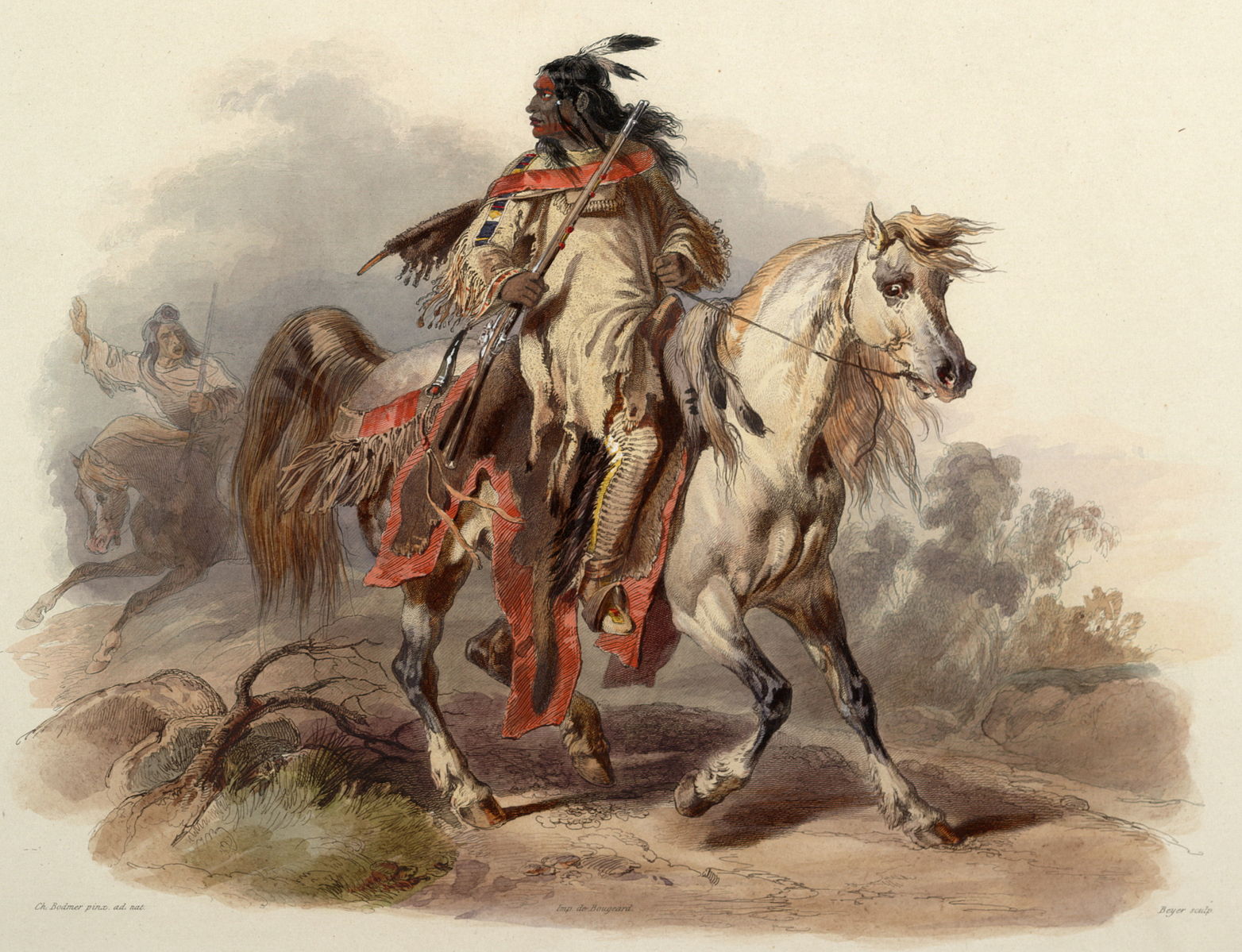
=

Presumably, whatever the case, while he is trying to manipulate both Indigenous people and Americans, they are trying to manipulate him, like this;
- March 24. They meet the Shoshone group again, flying an American flag at the mouth of the Raft River. The Shoshones inform them that the Americans had been on Bear’s River in February.
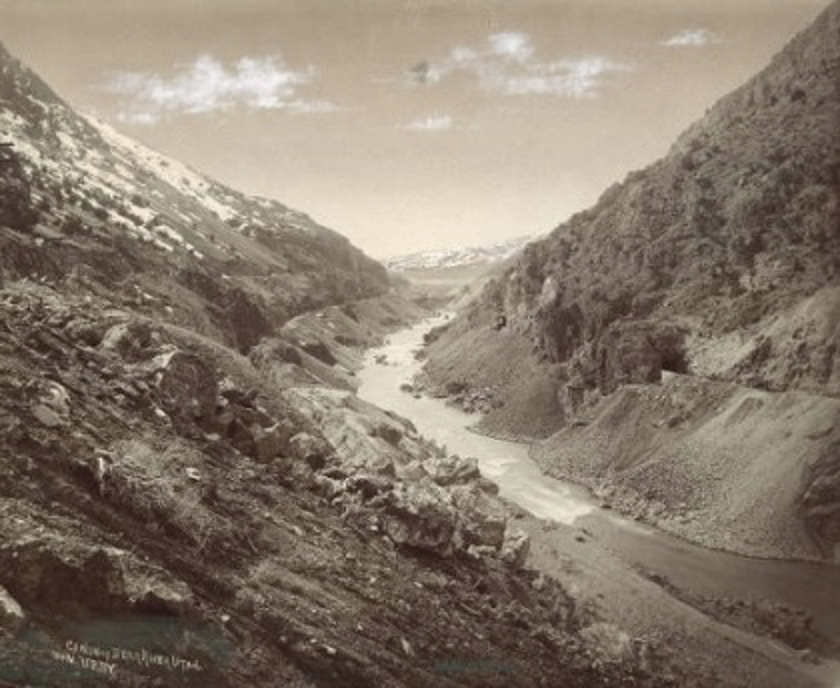
Bear River Canyon, Utah, 1869
Fur trade trails through this beaverless landscape have become roads and railroads by this point. Hardly horse country, though. Source.
- March 25. Because of the ongoing theft of horses between the Shoshones and Blackfoot, the expedition sets a guard on their horses now, but lose 13 beaver traps to theft. They meet up with the Blackfeet and the Piegans, all out to steal horses from the Shoshones.
- April 1. They meet up with a group of Nimiípu’u, out to steal horses from the Shoshones.
A long history there. The Shoshone got their horses from the Pueblos in the Southwest. The Nimíipuu and Blackfeet got theirs from the Shoshone. The HBC got theirs from the Nimíipuu. In other words…
They all had the same horses!
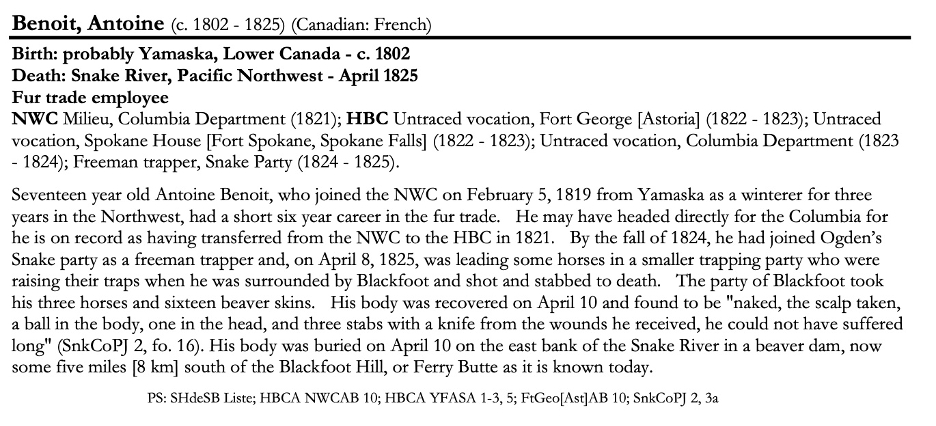
- April 3. They are at Benoit’s grave. He died in a skirmish the year before.
- April 7. They are surrounded by various tribes, all intent on stealing horses, from them if need be.
- April 9. Still harried by Blackfoot horse thieves, they meet up with a party of American traders and a group of their own men, Iroquois (including Pierre) who had deserted to the Americans the year before.
- April 10. Mr. McKay kills a man attempting to steal a horse. The deserters, including Pierre, pay their debts. They are now free.
- April 11. Defectors, Antoine Godin’s son, Young Findlay, and Lounge (a Canadian), leave the Americans for the HBC camp.
- April 15. The Piegans set fire to the prairie to harass the group.
Sorely harassed, Ogden sets up shop as a horse thief himself:
- April 22. Ogden beats three Métis Canadian men for trying to defect to the Americans, and steals their horses.
And by this point the Shoshone are trying to lure the British into a controntation with the Americans.
- May 21. The Shoshone inform Ogden’s group that the Americans are just ahead of them.
The next day, there’s a reckoning across the British-American-Spanish divide. This is the real border between Britain and the United States, north-south along the Rocky Mountains between California and Blackfoot Country. Here’s Ogden, scribbling it all down:
Sunday 22nd. As we were on the eve of Starting this Morning one of our Trappers arrived in Company with two of our Freemen who deserted from the Flat Head Post 1822 they belong to a party of 30 men who were fitted out by the Spaniards & Traders on the Missouri & have Spent the winter in this quarter & have met with little Success of the 14 who deserted 6 are dead & the remainder with the Spaniards, at St. Louis & Missouri
This was war.
…the Americans had a battle last fall with the Snakes & of the former & one of our deserters Patrick O’Connor were killed & only one Snake fell – there is no water.
Here are Ogden’s notes from the next day, when the Americans arrive and start trying to lure Ogden’s men away with a price-per-beaver exceeding actual trade value (We’ll see more of this on the Columbia in the next post):
Monday 23rd. …early in the day a party of 15 men Canadians & Spainards headed by one Provost & Francois one of our deserters, arrived, and also in the afternoon arrived in Company with 14 of our absent men a party of 25 Americans with Colours flying the later party headed by one Gardner …
Ogden might be trying to manipulate the Americans by killing beavers, but Gardner is not above trying to manipulate the Iroquois to block Ogden. As Ogden relates, that goes like this:
they … lost no time in informing all hands in Camp that they were in the United States Territories & were all free indebted or engaged & to add to this they would pay Cash for their Beaver 3 1/2 dollars p. lb., & their goods cheap in proportion our Freemen in lieu of Seeking Beaver have been with the Americans no doubt plotting.
Ironically, when Ogden was young, he himself was engaged in such shenanigans between the Northwest Company and the HBC. His murderous violence at that time was why he was chosen for this expedition. He was expected to treat the Americans in the same brutal way. Again, ironically, it was the Iroquois he wound up trying to control, stayed from violence because he needed them to trap furs to block the Americans, while he couldn’t attack the Americans due to the geopolitical nature of the clash. The losers were the Native people, including both Indigenous humans, bears, deer and beavers. Ogden continues the next day, scribbling as usual:
Tuesday 24th. This morning Gardner came to my Tent after a few words of no import, he questioned me as follows Do you know in whose Country you are? to which I made answer that I did not as it was not determined between Great Britain America to whom it belonged, to which he made answer that it was that it had been ceded to the latter & as I had no license to trap or trade to return from whence I came to this I made answer when we receive orders from the British Government we Shall obey, then he replied remain at your peril, he then departed & seeing him go into John Grey an American & half Iroquois Tent one of my Freemen I followed him, on entering this Villain Grey said I must now tell you that all the Iroquois as well as myself have long wished for an opportunity to join the Americans & if we did not Sooner it was owing to our bad luck in not meeting with them, but now we go & all you Can Say Cannot prevent us
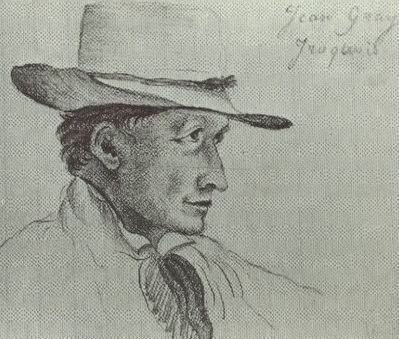
Ignace Hatchiorauquasha, aka John Grey, son of a Scottish soldier of the American Revolution and a Mohawk woman.
An American Iroquois working for the British after the Debacle of the War of 1812, in which American Iroquois Lost Everything to the Americans after Promises Made by the British Were Not Kept!
Gardner was Silent having only made one remark as follows, you have had these men already too long in your Service & have most Shamefully imposed on them selling them goods at high prices & giving them nothing for their Skins on which he retired,
True enough.
Grey then said that is true and alluding to the gentlemen he had been with in the Columbia they are Says he the greatest Villains in the World & if they were here this day I would Shoot them but as for you Sir you have dealt fair with me & with us all, but go we will we are now in a free Country & have Friends here to Support us & if every man in the Camp does not leave you they do not Seek their own interest, he then gave orders to his Partners to raise Camp & immediately all the Iroquois were in motion, & made ready to Start this example was Soon followed by others at this time the Americans headed by Gardner & accompanied by two of our Iroquois who had been with them the last two years advanced to Support & assist all who were inclined to desert, Lazard an Iroquois now Called out we are Superior in numbers to them let us fire & pillage them
All the casual murdering and horse stealing has infected them all.
on Saying this he advanced with his Gun Cocked & pointed at me but finding I was determined not to allow him or others to pillage us of our Horses as they had already taken two say Old Pierres which had been lent him, they desisted & we Secured the ten Horses but not without enduring the most opprobious terms they could think of from both Americans & Iroquois all this time with the exception of Messrs. Kittson & McKay & two of the engaged men & the latter not before they were Called Came to our assistance thus we were overpowered by numbers these Villains 11 in number with Duford, Perrault and Kanota escaped with their Furs in fact some of them had conveyed theirs in the night to the American Camp. A Carson & Annance paid their debts & followed the example of the others, I cannot but Consider it a fortunate Circumstance I did not fire for had I I have not the least doubt all was gone, property & furs
Property could, in other words, be treated as legitimate war compensation, just as defenders of an Indigenous village under attack could be enslaved. And it is still going on today:
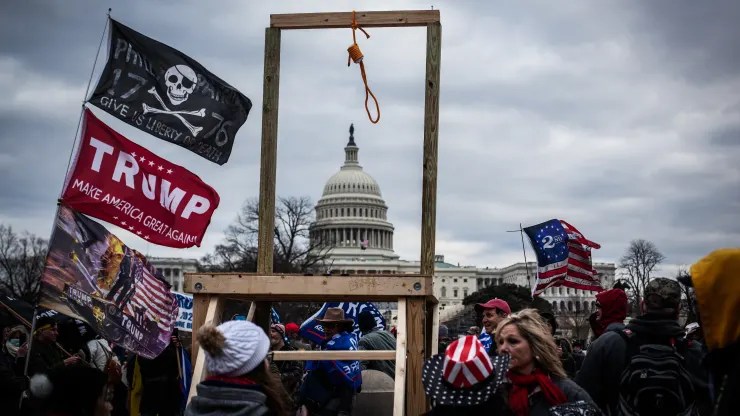
indeed this was their plan that I should fire assuredly they did all they Could to make me but I was fully aware of their plan & by that means Saved what remains…
In a territory equally shared by Britain and the United States, Britain’s aristocratic methods were losing control. Ogden saw that much clearly.
From the above affair I am now Convinced the 6 absent men they have Secured & it would be folly in me to delay my departure for their arrival, indeed I fear many of the Freemen will yet leave us.
11 men defected! Perhaps 6 more! All free Iroquois whose ability to calculate profit and loss was not inconsiderable. They knew about slavery. They didn’t want it. As they had told Alexander Ross on the previous expedition:
Friday, 13th [1824]. Early this a.m. the Iroquois asked to see their accounts. I showed them article by article and showed them their amounts wh. seemed to surprise them not a little. Some time after leaving camp I was told that the worthy Iroquois had remained behind. I therefore went back, and true enough, the whole black squad, Martin excepted, had resolved to leave us, old Pierre at their head! On being asked the cause Pierre spoke at length. The others grumbled, saying the price allowed for their furs was so small in proportion to the exorbitant advance on goods sold them, they were never able to pay their debts much less make money and would not risk their lives any more in the Snake Country. Old Pierre held out that Mr. Ogden last fall promised there would be no more N. W. currency; this they construed to be paying half for their goods.
They were referring to the system of payment within the HBC brigades: a freeman was advanced traps, food and supplies from the HBC store; furs brought in were assessed a price and noted in a ledger against these costs; the free trapper then had to pay the initial outfitting costs back when the brigade returned to camp. Any excess was their wages for the year. The Iroquois complaint was that all the road-building necessary for the expedition, as well as orders to work in brigades among general HBC employees (who were paid a simple wage and not so motivated to work hard), reduced the number of beavers the Iroquois could kill in proportion to the hours they put in. Even more irritating, payment for the outfitted goods was at a high retail price and price for the beavers at a low wholesale one. Under these conditions, it was impossible to pay off one’s debt, no matter how hard one worked. One was effectively working as a slave. Payment in HBC scrip…

HBC Scrip from British Columbia in the 1930s
…rather than currency worsened the discrepancy, as any profit could only be redeemed at the HBC . It’s a well-known system. My grandparents, Bruno and Martha Leipe, worked under it growing tomatoes on old Okanagan Mission lands in 1929. Here they are:
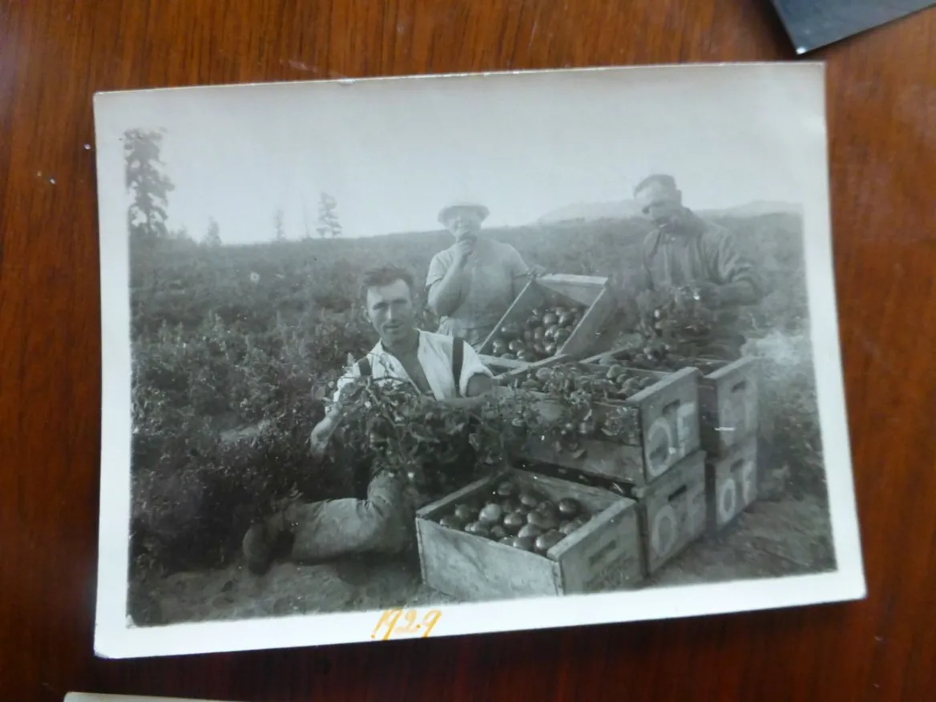
They were to be paid in scrip from John Casorso’s store. When the world economy tanked and tomatoes were unsaleable, he generously wrote off their debt. The HBC was not so generous. You can read more here.
On Ogden’s expedition, such generosity was lacking, even though Ogden came from a family of Quakers, known for just that. Still, he was also from a family driven out of the United States after the Revolution. He had lost much to the Americans already, and had a youth applying native methods of warfare to Euro-American competition. This was personal to him. There was also not a lot of pleasure in representing an aristocracy when no-one would do as he said. Threats of a general war were made, independent of the actions or knowledge of either the US or British governments. Ogden gave up all pretense of organization and spilled out his frustration at speed:
Wednesday 25th.-Late last evening … I conversed with Some of the Freemen & engaged men to know if they would assist in defending the Company’s property in Case of attack and they said they would we made all necessary preparations in Case of attack & kept Strict guard during the Night, at day light I gave the Call to raise Camp, scarcely had we begun loading our Horses, when the Americans & three of our Iroquois Came to our Camp but finding us prepared kept quiet Soon after Mr. Montour, Clement & Prudhomme came forward & told me they intended joining the Americans that they were free & not indebted I endeavored to reason with Mr. Montour but all in vain, the reasons he gave for his villany were the Company turned me out of doors they have £260 of my money in their hands which they intend to defraud me of as they have refused to give me interest for but they may keep it now for my debt & Prudhoms. which we have Contracted in the Columbia as for Clement he has a Balce. in the Compys. Book; go we will where we shall be paid for our Furs & not be imposed & cheated as we are in the Columbia
Not realizing, perhaps, that they would soon be cheated by the Americans as well. Even Gardner is up to a bit of bluffing.
on my mounting my Horse Gardner Came forward & Said you will See us shortly not only in the Columbia but at the Flat Heads & Cootanies we are determined you Shall no longer remain in our Territory. to this I made answer when we Should receive orders from our Government to leave the Columbia we would but Not before to this he replied our Troops will make you this Fall
Ogden now assesses his failure:
Here I am now with only 20 Trappers Surrounded on all Sides by enemies & our expectations and hopes blasted for returns this year, to remain in this quarter any longer it would merely be to trap Beaver for the Americans for I Seriously apprehend there are Still more of the Trappers who would Willingly join them indeed the tempting offers made them independent the low price they Sell their goods are too great for them to resist & altho’ I represented to them all these offers were held out to them as so many baits
Baits like a trapper lays for a beaver! Which Ogden (tied up as surely as a horse or a slave being broken) must endure.
I have now no other alternative left but direct my Course towards Salmon River without loss of time, to follow up my Second intentions in proceeding by the Walla Walla route is now in a manner rendered impracticable as our numbers are by far too few, as nearly one half of the Trappers are determined to return to Fort des Prairies so if we divide again neither party would Stand a chance of ever reaching the Columbia, there is now No alternative I must bend & Submit to the will of the party.
Then the Iroquois get the better of him in another way, apparently secretly selling their furs to the Americans, keeping their horses, and keeping Ogden’s protection, at Ogden’s cost:
Thursday 26th.-Late last evening two of the six absent men joined us they had Seen nothing of the remaining four By their accounts as they were on their return to the Camp yesterday they fell in with an American party from 30 to 40 men as they Say Troops, who on Seeing them Called to them to advance which they did, their traps 15 in number 16 Beaver & their two Horses were taken from them they were then told if they would remain with them & not return & Join me their property would be restored to them otherwise not, they were Strictly guarded during the day & while in the act of changing Watches about midnight last night they effected their escape leaving all behind them how far this is Correct I cannot Say it may be probably made to Suit intentions as they have both Women & Horses perhaps they will now Watch an opportunity to return …
After Ogden’s mile-long caravan of trappers, horses, pelts and their wives and 45 children breaks away from the Americans, things continue as usual:
- June 2. They meet a Shoshone, who had stolen their gear a year before, a year after murdering 9 Americans (and stealing all their gear), as well as the gear of a succeeding group of Americans.
- June 3. Ogden reports that the only way to get food from the Shoshones is to steal it by force and then pay them back later. That he expected open welcome instead is quite astonishing.
- June 8. They encounter a Shoshone group who have stolen 180 traps, as well as guns and knives, from the Americans, and have set themselves up as traders in their own right. The Americans are on their trail, hoping to destroy them.
- June 10-11. They are followed by Shoshones intent on stealing their horses. There is a skirmish. None are killed.
To sum up: 3500 beavers, a few other furs, for a value of £2533.18. With the cost of wages and supplies, and especially the death of so many horses bought at inflated prices along the way and which they were later forced to eat, there was in the end neither an immediate profit or loss.
Except for the Iroquois, who went broke, and all the death . Just the reported deaths here, from 2 HBC expeditions, 1 Spanish one, and 5 American ones over 2 years, adds up to 30, and even that a tiny fraction of the total for the mountains as a whole. Previous expeditions entered valleys to trap for beaver only after gunfights with their Indigenous watch keepers, which left hundreds dead. What’s more, a decade after Ogden’s expedition almost all of Ogden’s men had died in this ongoing war, in which:
- people fought for beavers,
- with guns bought with beavers,
- against the men who sold them the guns.
That’s to say, Ogden’s men, the Mixed Blood sons of New France, the Hudson’s Bay Company and the Northwest Company died out there, whoever they were working for, and thousands of Indigenous men with them.
It was a sad romantic gesture.
Tensions were tight and nerves were frayed in this proxy war, but remember, it did not begin here, in began in Astoria, where it didn’t begin either, and in Assiniboia, where it also didn’t begin, and in the War of 1812. For Ogden and the Iroquois at least, it began in the US Revolutionary War, while for the French it began in the Battle for Quebec, but that’s all a rabbit hole. It was July, 1832. There was a rendezvous. Every year, mountain men, traders and Indigenous peoples would gather for a couple weeks in a valley in the mountains to trade. Their goal was to avoid the expense of a permanent trading fort in favour of trapping the beavers themselves.

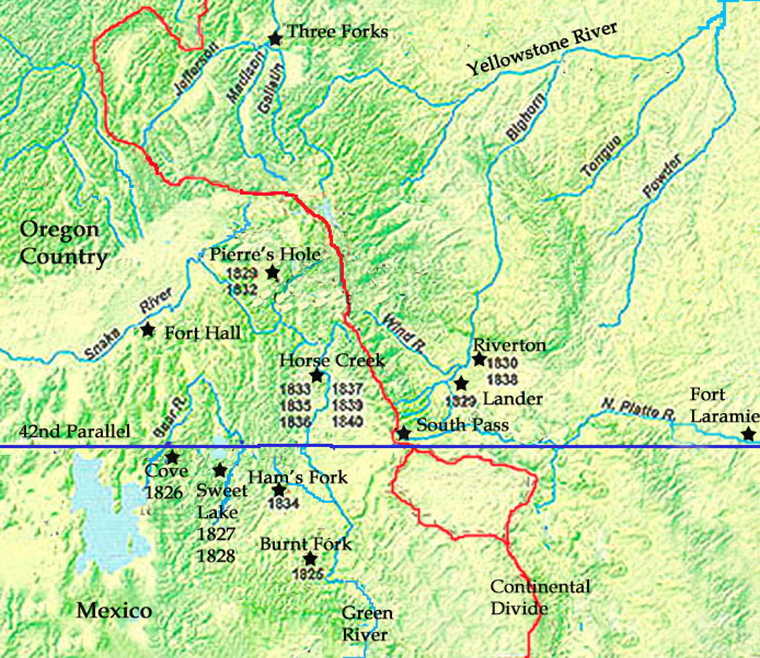
Their annual trading camps were called Rendezvous. They were:
- 1815: LaRamée’s rendezvous, at the junction of the North Platte and the Laramie rivers, Wyoming.
- 1822: No Rendezvous. William Ashley out of St. Louis, urged to set up a post to serve the Arikara, a trading nation that had been isolated in trade by the Sioux now that Canadians were no longer trading south of the 49th Parallel, lied and said a shipment of goods would come directly from St. Louis by boat.
- 1823: No Rendezvous. William Ashley’s trading party tried to buy horses from the Arikara, but balked at the high prices. They didn’t have enough trade goods on hand to meet the requests. Anger was high because of his lies the year before and on June 2 the Arikara attacked. 13 of his men were killed and 10 wounded, including the young Jim Bridger.
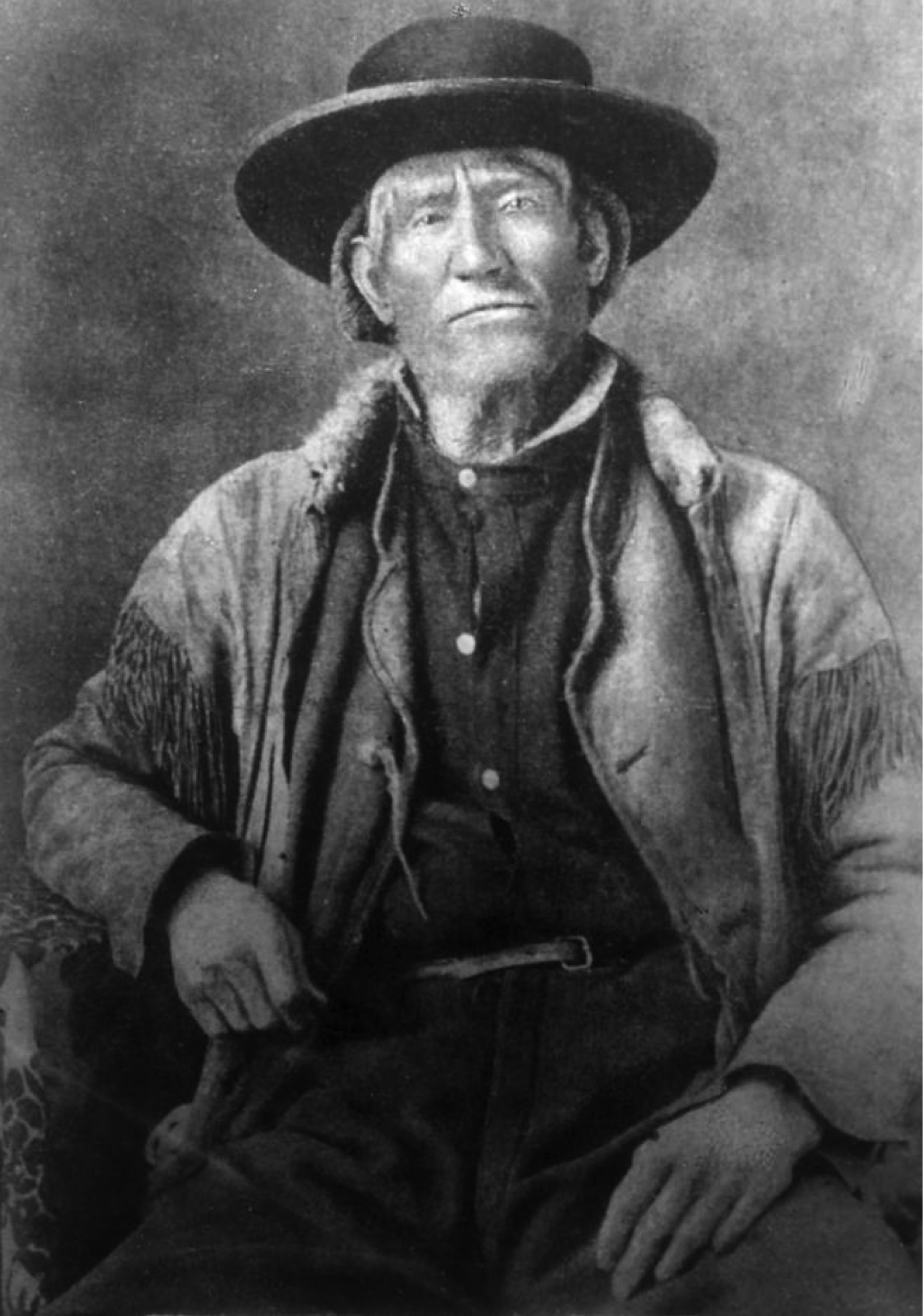
Remember him? Note the scarred face from that encounter.
Ashley fled downriver and called for the US Army to punish the Arikara. They did. Ashley’s men and a host of other volunteers and 750 Sioux, up to their old tricks at maintaining trade dominance, helped out. The important thing to keep your eye on here is that Indigenous people in the borderlands were no longer living off the land. They were living by brokering trade with people still living off the land, such as Ogden’s Iroquois. The Americans were doing the same thing. So were the British. Anything else was a fantasy.
- 1825: McKinnon, Wyoming.[2] Just north of McKinnon along Henrys Fork. They joined members of William Henry Ashley‘s expedition.[3] At this rendezvous, Jedediah Smith became Ashley’s partner in the fur trade.

1825 Burnt Fork Rendezvous – N41° 2′ 33.1″ W109° 59′ 39.2″. Source: http://thefurtrapper.com/home/rendezvous-sites/
Here we meet the Iroquois who gave Ogden the cold shoulder, with 700 pelts to trade:
On the 1st day of july, all the men in my employ or with whom I had any concern in the country, together with twenty-nine, who had recently withdrawn from the Hudson Bay company, making in all 120 men, were assembled in two camps near each other about 20 miles distant from the place appointed by me as a general rendezvous, when it appeared that we had been scattered over the territory west of the mountains in small detachments from the 38th to the 44th degree of latitude, and the only injury we had sustained by Indian depredations was the stealing of 17 horses by the Crows on the night of the 2nd april, as before mentioned, and the loss of one man killed on the headwaters of the Rio Colorado, by a party of Indians unknown.
- 1826: Cache Valley, Utah, either at today’s Cove or at the more southern Hyrum. After the rendezvous, Ashley and Smith continued up to the Bear River where they met up with David Jackson and William Sublette. Smith, Jackson and Sublette bought out Ashley’s share of the fur company.
- 1827: Bear Lake, near today’s Laketown, Utah. Conflicts and fights with Blackfoot Indians occurred during the meeting.
- 1828: Bear Lake. More fights with the Blackfoot occurred.
- 1829: Lander, Wyoming.
- 1830: Riverton, Wyoming. Smith, Jackson and Sublette sold their company to Jim Bridger, Thomas Fitzpatrick, Milton Sublette (the brother of William), Henry Freab and Baptiste Gervais.
Remember Bridger?

He would go on to build Fort Bridger, a key link in the Oregon Trail.

Note that the market for American trade wasn’t the Sioux now but migrants to Oregon. The beavers that Ogden had worked so hard to destroy, as a means to stopping the Americans and ensuring a HBC trade monopoly, were no longer currency. Land and money were.
- 1831: Cache Valley. The support trek was late, so there was no real rendezvous.
- 1832: Pierre’s Hole, east of Rexburg, Idaho.

Pierre’s Hole, Idaho – N43° 46′ 25″ W111° 10′ 20″ Source.
The main supplier for the site was William Sublette. He was not entirely above board: When William Sublette renewed his fur trade license [in 1832] and posted a bond to not sell whiskey to the Indians, he was allowed four hundred and fifty gallons of whiskey for his boatmen. The route Sublette used to the Pierre’s Hole rendezvous did not require the use of a single boatman.
450 gallons for his boatmen?

Well, I guess it was a good vintage.
A missionary called Marcus Whitman was part of the party. He was there because he was answering the Iroquois call, the one in which they asked William Clark to broker some spiritual leadership for them. Whitman, who was also a doctor, removed an arrowhead from Jim Bridger’s back. His presence showed that not only were land and money the new currency in the Pacific Northwest, but so were souls. The old game of diplomatic slavery was about to find a new expression. The Rendezvous tradition continued…
- 1833: Upper Green River Rendezvous Site, Daniel, Wyoming.
- 1834: Granger, Wyoming. The Rocky Mountain Fur Company was dissolved, and the American Fur Company took over supplying the rendezvous.
- 1835: Daniel, Wyoming.
- 1836: Daniel, Wyoming.
- 1837: Daniel, Wyoming.
- 1838: Riverton, Wyoming.
- 1839: Daniel, Wyoming.
- 1840: Daniel, Wyoming.
And all together:
Eventually, there was a day of shooting: July 17, 1832.
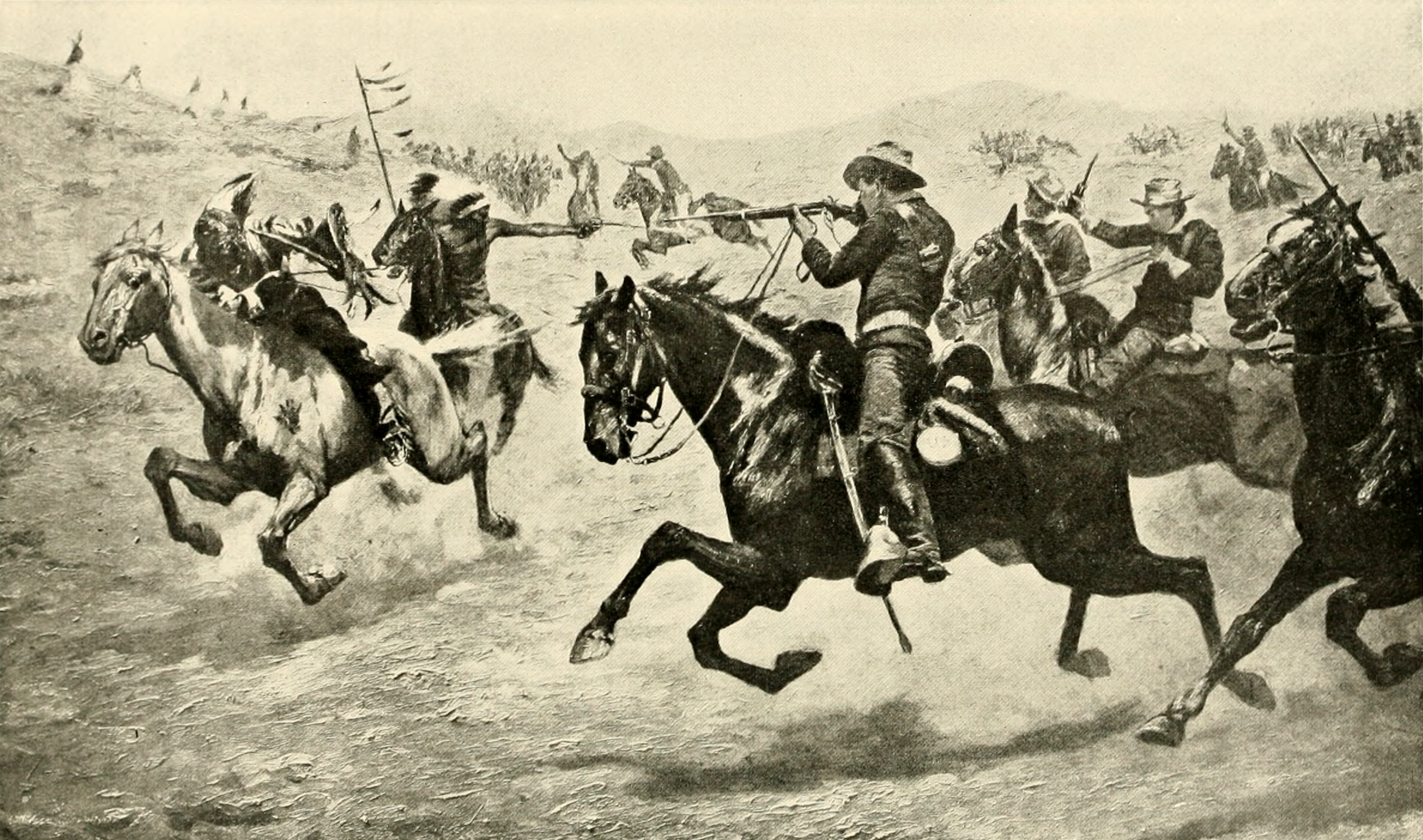
The Battle of Pierre’s Hole
Image from Joseph Gaston’s Centennial History of Oregon. Before 1910. Artist unknown. Source.
The tensions of a half century of the old Northwest came to a head that day after two French Canadian Iroquois métis men, Antoine Godin and another, identified either as a “Flathead” (Salish) chief or Baptiste Dorion,” (grandson of Lewis and Clarke’s Sioux interpreter Pierre Dorian,) settled an old grievance by murdering an Atsina chief offering peace — or appearing to. Before that, all that whiskey had to finished off, furs traded, and hunting parties had to go out and shoot whatever they could get a bead on. After all, there were a lot of people, and this was as much a festival as a business meeting. It wouldn’t do to eat porridge or beans at a party. It’s no different today.
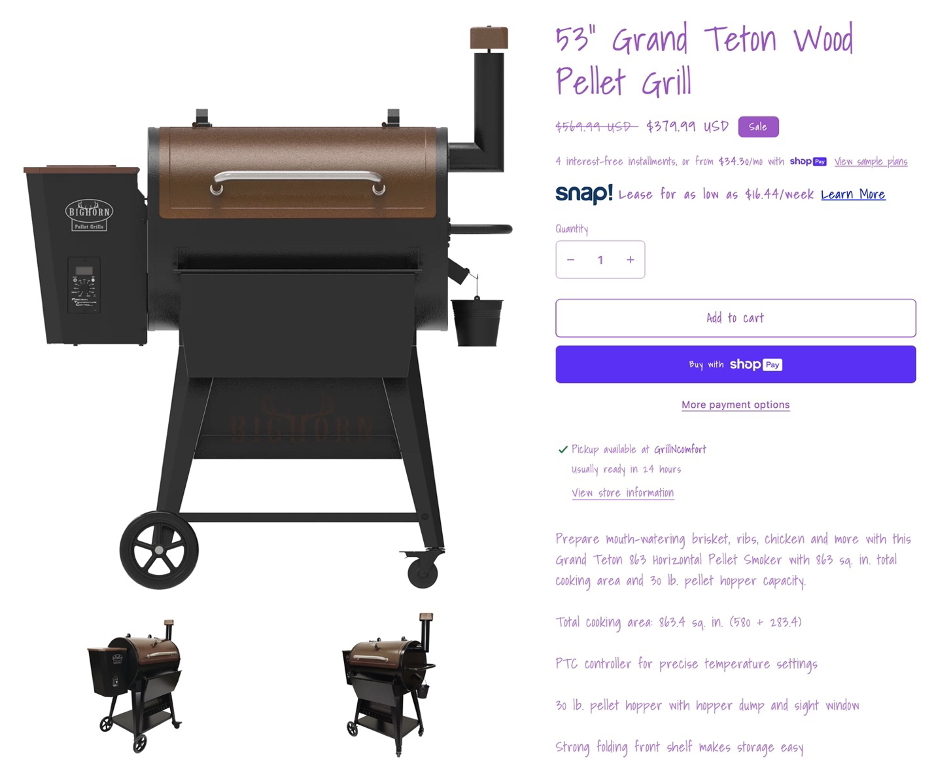
A Metal Buffalo on Wheels
Grilling is a thing.
At any rate, there were a lot of people and horses to feed:
Indian and mountain man camps extended from Teton Creek on the south end of present-day Driggs, north along the west side of the Teton Mountains to Tetonia. The camps covered an area of seven square miles, or more.
All of the mountain men who would play a role in the Oregon Indian Wars to come were there. Pierre Bonneville, the French-born U.S. Army officer tasked with breaking into the Hudson’s Bay Company Empire in Oregon, described the scene with French eyes turned into the stuff of legend by his ghost writer, Washington Irving:
In this valley was congregated the motley populace connected with the fur trade. Here the two rival companies had their encampments, with their retainers of all kinds: traders, trappers, hunters, and half-breeds, assembled from all quarters, awaiting their yearly supplies, and their orders to start off in new directions. Here, also, the savage tribes connected with the trade, the Nez Perces or Chopunnish [Yakama, not Nez Perce] Indians, and Flatheads, had pitched their lodges beside the streams, and with their squaws, awaited the distribution of goods and finery. There was, moreover, a band of fifteen free trappers, commanded by a gallant leader from Arkansas, named Sinclair, who held their encampment a little apart from the rest. Such was the wild and heterogeneous assemblage, amounting to several hundred men, civilized and savage, distributed in tents and lodges in the several camps. Source.
They covered a large area!

Not just to keep some privacy, but to look after the horses, which needed grass and water, and to provide access for hunting parties up the creek valleys into the mountains. The model is not American but Indigenous.
Here’s how Alexander Ross described a Kittitas salmon camp of much the same size in 1814.
It could not have contained less than 3000 men, exclusive of women and children, and treble that number of horses. It was a grand and imposing sight in the wilderness, covering more than six miles in every direction. Councils, root-gathering, hunting, horse-racing, foot-racing, gambling, singing, dancing, drumming, yelling, and a thousand other things, which I cannot mention, were going on around us.
The din of men, the noise of women, the screaming of children, the tramping of horses, and howling of dogs, was more than can well be described….In this field of savage glory all was motion and commotion; we advanced through groups of men and bands of horses, till we reached the very centre of the camp, and there the sight of the chiefs’ tents admonished us to dismount and pay them our respects, as we depended on them for our protection.
Alexander Ross. The Fur Hunters of the Far West: a narrative of adventures in the Oregon and Rocky Mountains

Twenty-first century accounts question Ross’s estimate, on the grounds that accurate historical reports (from the late 19th century) of other gatherings suggest a size closer to 1500 people, not the 3,000 men and perhaps 10,000, 12,000 or 15,000 (calculations vary) in total that Ross describes, yet historical records of the summer salmon fishery at the confluence of Na-sik-elt Creek and the Pisquouse (Wináatshapam) River (today’s city of Leavenworth) give totals of 3,000-4,000 people, gathered from a much smaller region, so it’s not beyond the possible. Today, you can stop in at the Na-sik-elt fishery and get a German sausage and some Midwest sweet mustard, while an accordionist in Lederhosen plays Walt Disney tunes by request or, if you don’t request, all on his own, but back then it was salmon and berries where the mountains met the grass but no sweet mustard, which is a good thing.
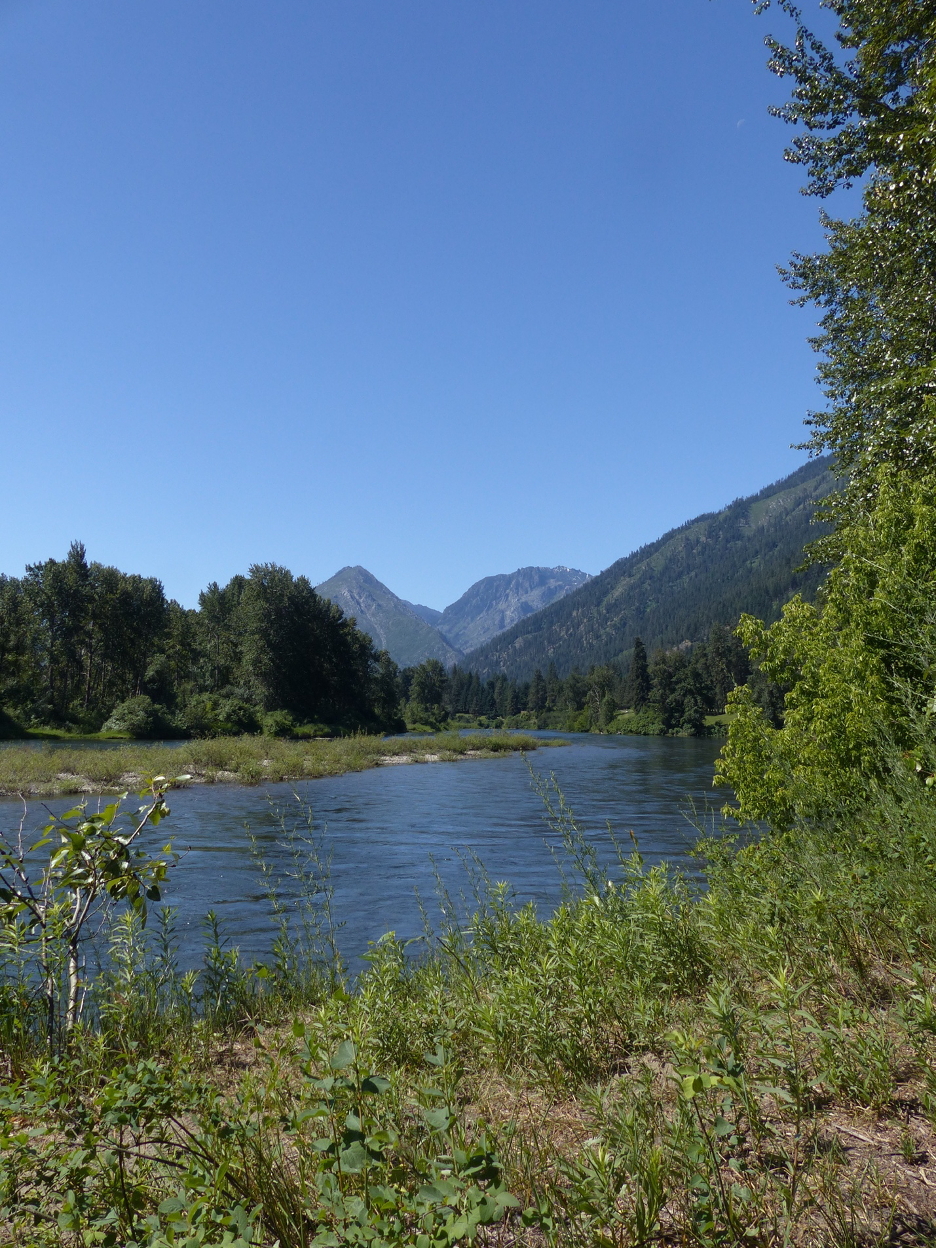
The Wenatchee River in Leavenworth Today
With a view up to the “Icicle” Fishery, after its retirement as a log booming ground.
In her book Snoqualmie Pass: From Indian Trail to Interstate…

Yvonne Prater gives a portrait without Ross’s sensationalism:
Every few years Indians from all Northwest tribes gathered at a large camp in the Kittitas Valley, adjacent to the trail, to hold council talks, make peace, settle disputes, trade, socialize, and dig roots from high-producing grounds nearby. The gathering place was known as Che-ho-lan. There were ample springs of water nearby and the creeks carried their spring runoff to the Yakima River…While the women and children dug kouse and penua (sweet potato), the men rode off to hunt. At the same time, there were horse racing and stick bone playing. Chained bears and wolves added to the noise. There was also a great deal of trading going on.
What was being traded? Dentalium shell necklaces from the coast; shell and abalone money; shell adornment for ear and nose wearing; copper bracelets; obsidian scrapers; arrowheads and other items from Oregon or British Columbia; hair from mountain goats and dogs for weaving blankets; bark and various roots for basket weaving; owl’s-foot necklaces; antler chippers; ornately carved wood, stone, and bone implements; buffalo robes and blankets from the plains Indians, brought back by plateau Indians who had “gone to buffalo” the year before.
And the men followed the creeks into the hills, hunting. It was a thing. The fur trader rendezvous system was an adaptation of this Indigenous tradition into European culture. Unfortunately, with whiskey.
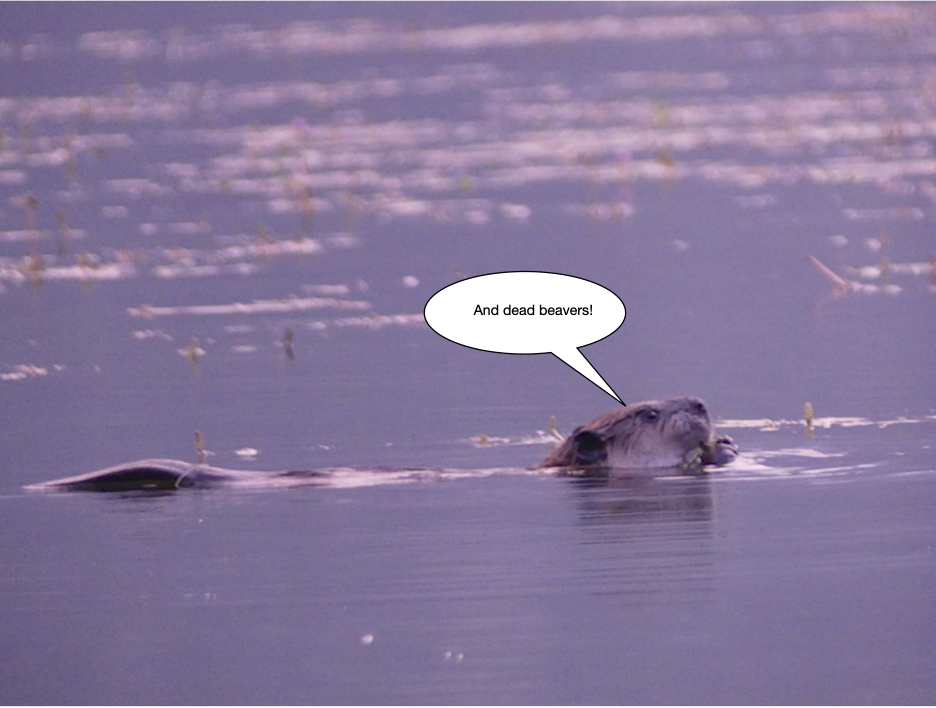
Photo by Harold Rhenisch
Actually, all the behaviour described here was an adaptation of Indigenous culture, just with deadly violence and subjugation added. For example,around July 17, 1832, after the trappers had exchanged their furs, were paid and equipped for the coming year, and the tribes had traded their goods, the camp started to break up. Then there was trouble. Milton Sublette, brother of William Sublette (who supplied the rendezvous), left with his crew of 100 and a few mountain men for the trapping regions out of Salt Lake. About that:

The Green Dot Here is Pierre’s Hole (Below the ‘o’ of Idaho.)
The British and Americans shared Oregon in 1832. Britain and Mexico allowed free passage of their citizens, which is why Ogden was able to pass down into Utah. The USA and Mexico had signed a treaty that kept Americans out of Mexico (And Utah). Milton Sublette had ignored that for years. For example, during an Apache attack on the Gila River in September, 1826 he was wounded in the leg. The wound never healed. What’s pertinent is that this attack had taken place in Mexico, which the Apache were raiding for slaves after replacing the Utes in the trade, who had been raiding them for slaves. Texas was agitating for independence from Mexico that year. Milton’s activities were part of this unofficial, behind-the-scenes war of conquest. Have another look:
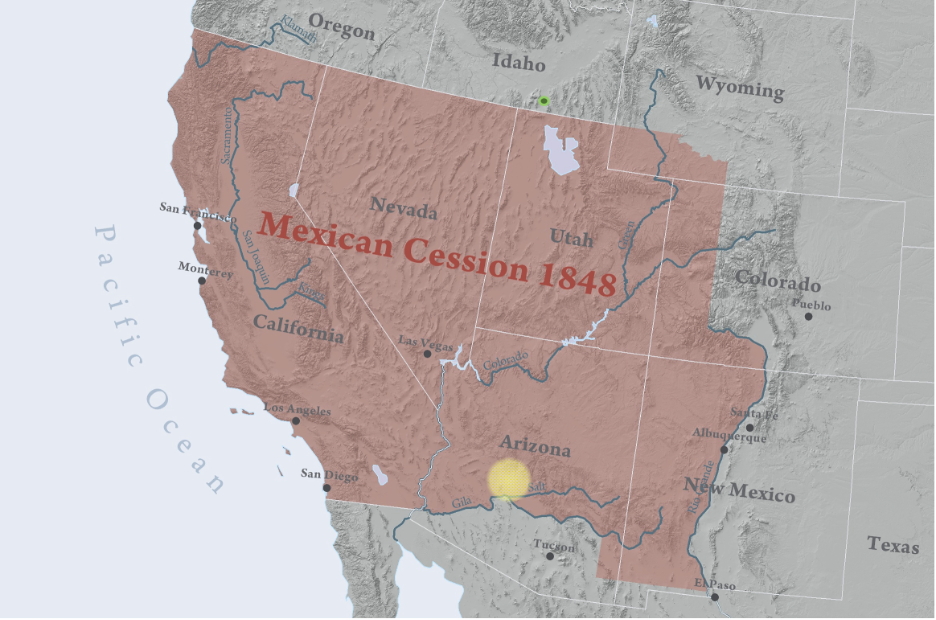
The Yellow Circle shows the Heart of Apache Territory on the Gila River in 1832
1848 was the year this unofficial war for territory was finally resolved by Treaty.
Leaving Pierre’s Hole with Milton Sublette was Nathaniel Wyeth. After Wyeth’s men were killed in fights with tribes or deserted, he would land penniless in the Willamette Valley late that year, wearing a new shirt given him by the HBC. There he would look out over the French-Canadian farms of French Prairie and decide that he had found paradise. The British idealized it as well. For example, here’s the Willamette Valley looking over Mount Hood in 1845, with a pair of Kalapuyans looking decidedly roman…
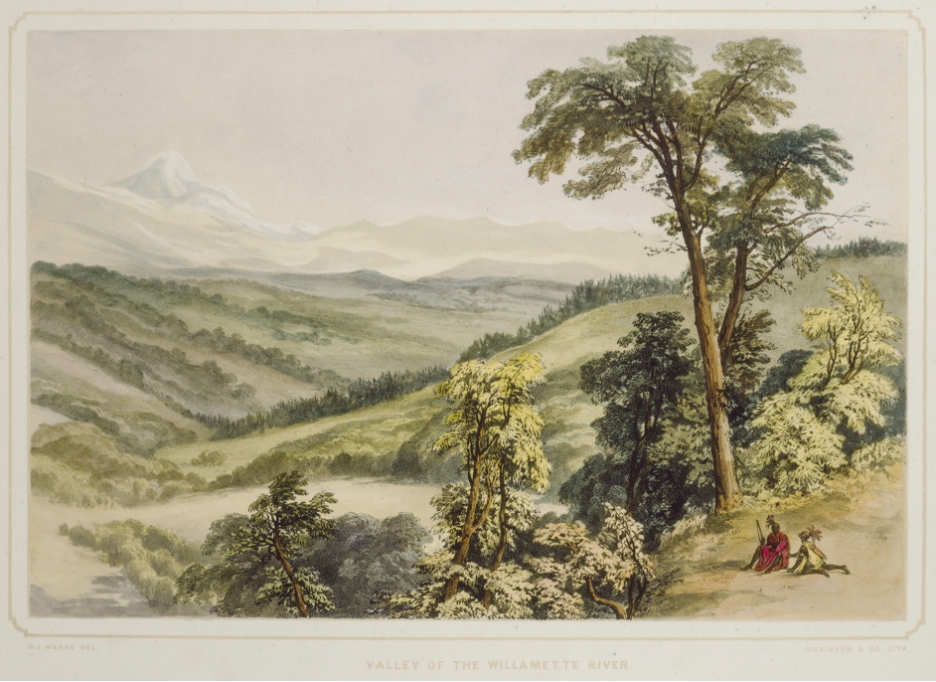
Lieutenant Henry J. Warre, British Army spy.
… and here is the British Estate of Boxhill …

Alexander Munro’s Boxhill from West Humble Lane, undated
And here Munro has a go at Italy

Classical Landscape, by. Alexander Monro <1844
And here John Constantine has a go at Wales…

Stadler, J. C. (Joseph Constantine), fl. 1780-1812, engraver. Smith, John, 1749-1831, artist. – This image is available from the National Library of Wales
And here is James Pierce Barton’s idea of Kentucky in 1832:

Kentucky Landscape, 1832, James Pierce Barton
Apparently, ideals of perfection and pictorial balance are more visible than places themselves. What the land actually looked like, we will never know. Replacement of it with an ideal is the goal.
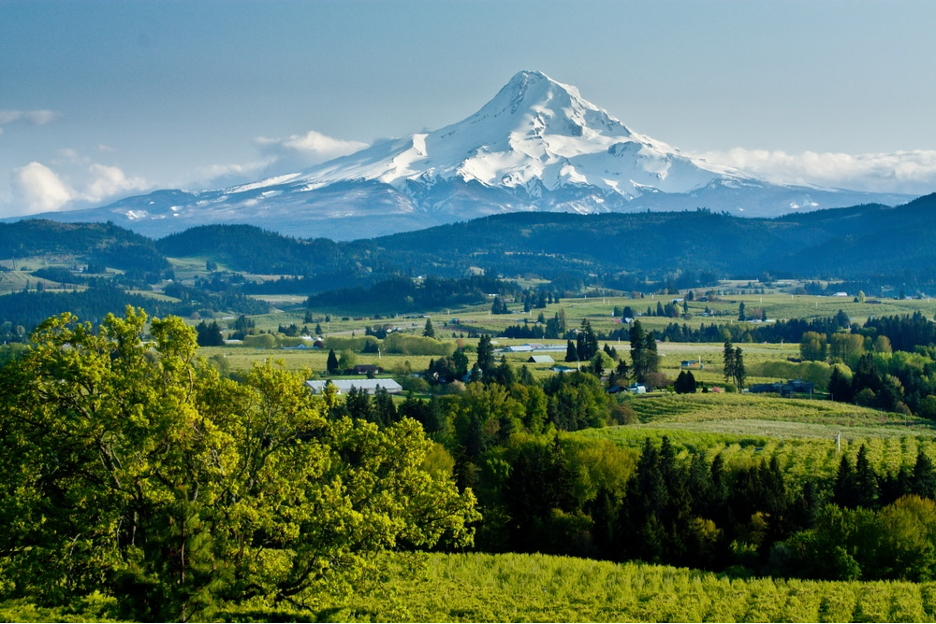
1845 Today. The tree is on the left now, that’s all. Source.
Here, let me fix that…
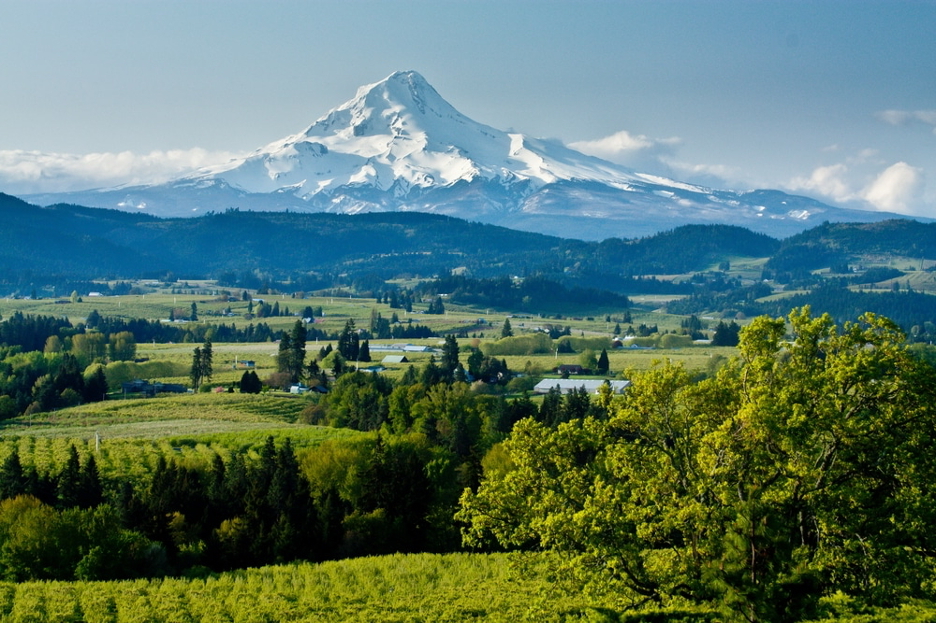

The HBC had been incorrect in thinking that it was fur traders who would cross the mountains. It was Astor’s dream. The United States would be a mobile country, a line rather than an expanse. At least for now.

This time it was the customers who were the brigade! What had started with Ashley’s caravan to the 1830 rendezvous…

Smith-Jackson-Sublette Expedition of 1830.
William H. Jackson sketch in Oregon Trail Museum. Source.
… going out to meet Indigenous people, became settled mountain men meeting caravans from the USA…

Breaking up Camp at Sunrise, by Alfred Jacob Miller (1858–1860). Source.
Wyeth returned in 1834, to compete head-to-head with the HBC, but with a different attitude to native peoples than the HBC’s. When he saw Wapato Island in the Columbia off Fort Vancouver, he saw opportunity, where the HBC had witnessed only the death of its trading partners:
Wyeth’s second trading station Fort William was built on Wapato Island (later called Sauvie Island), near present-day Portland, Oregon. Upon seeing the deserted Multnomah villages caused from recent disease epidemics, Wyeth noted that “providence has made room for me and with doing them [Natives] more injury than I should if I had made room for myself viz Killing them off.”[3]
Better yet, wapato, a wetland plantain with chestnut-like tubers, grew in mats along the oxbows of the river.

Bonneville himself grumbled about the land being held in bondage, like this:
The traders of the Hudson’s Bay Company have advantages over all competitors in the trade beyond the Rocky Mountains. That huge monopoly centers within itself not merely its own hereditary and long-established power and influence; but also those of its ancient rival, but now integral part, the famous Northwest Company. It has thus its races of traders, trappers, hunters, and voyageurs, born and brought up in its service, and inheriting from preceding generations a knowledge and aptitude in everything connected with Indian life, and Indian traffic. In the process of years, this company has been enabled to spread its ramifications in every direction; its system of intercourse is founded upon a long and intimate knowledge of the character and necessities of the various tribes; and of all the fastnesses, defiles, and favorable hunting grounds of the country. Their capital, also, and the manner in which their supplies are distributed at various posts, or forwarded by regular caravans, keep their traders well supplied, and enable them to furnish their goods to the Indians at a cheap rate. Their men, too, being chiefly drawn from the Canadas, where they enjoy great influence and control, are engaged at the most trifling wages, and supported at little cost; the provisions which they take with them being little more than Indian corn and grease. They are brought also into the most perfect discipline and subordination, especially when their leaders have once got them to their scene of action in the heart of the wilderness.
Then he summed up:
These circumstances combine to give the leaders of the Hudson’s Bay Company a decided advantage over all the American companies that come within their range, so that any close competition with them is almost hopeless.
He was very wrong. Other forms of bondage were to come into play, as well as the catastrophe of the missions in Old Oregon, including Marcus Whitman’s. That’s where we’re going next. See you at the Prince’s Cabin:

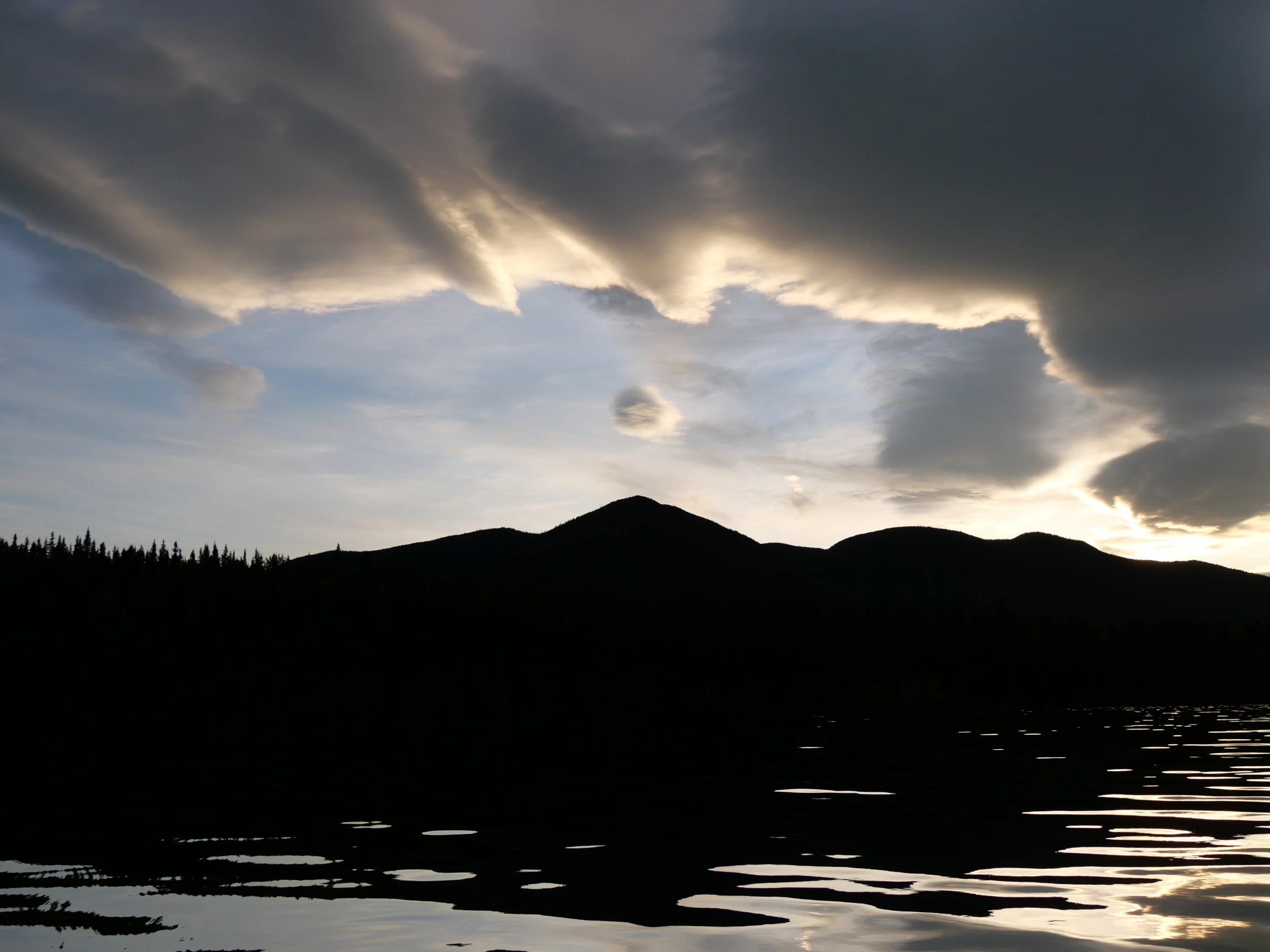
Photo by Harold Rhenisch
Categories: First Peoples, history, Nature Photography, Pacific Northwest

 Okanagan Okanogan

