


I left you with this image yesterday and said that all the balance and water we would ever need was here.
Now that you’ve had some time to live with the image, let’s talk. To locate it, this is an image of the west arm of Okanagan Lake at Minus 19 Celsius. It is in the process of freezing. This lake:

There is clear sky, fog over open water, and (in close) ice. The ice is covered with white spots. They are not snow. They are tiny fluffs of hoarfrost that has frozen on surface of the lake:
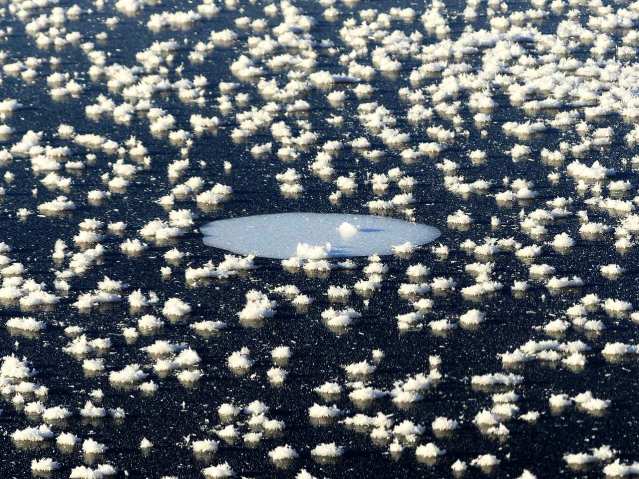
What you cannot see in the image is the water evaporating into the cold air — at minus 19. It drifts for a bit less than a metre then vanishes. Along the way, it builds frost.
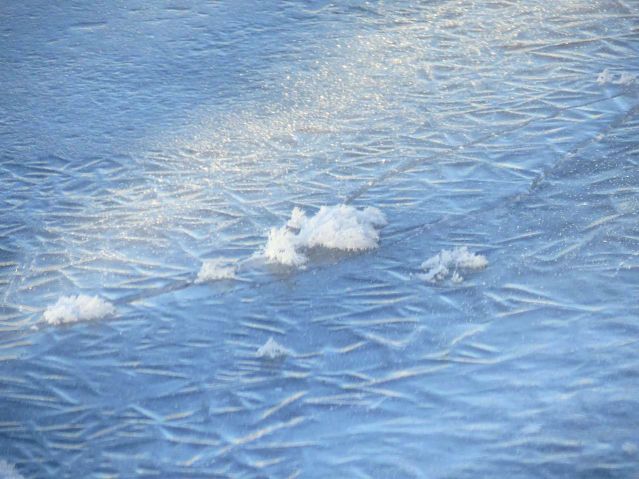 The specific texture of the ice surface doesn’t seem to matter.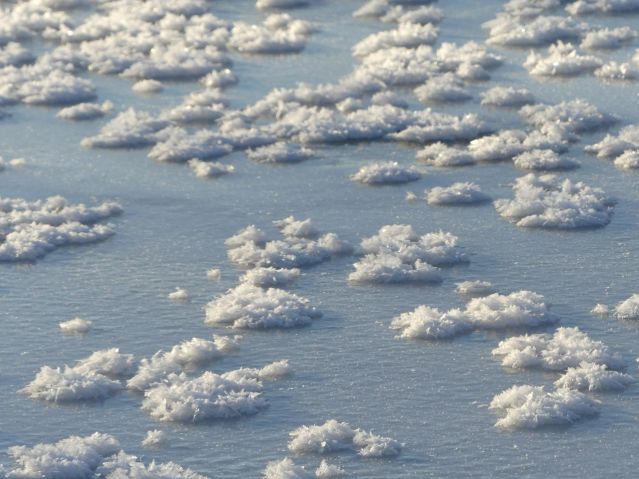
Perhaps, though, specific atmospheric conditions do matter; some of the ice, which should be evenly covered with frost feathers isn’t: seemingly a goose broke it …
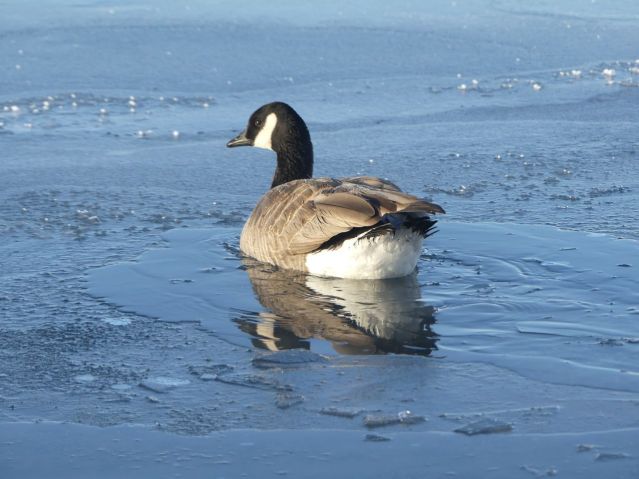
…at a critical point and the newly open water caught the hoarfrost upon freezing, while the older ice didn’t, or at least not so much.
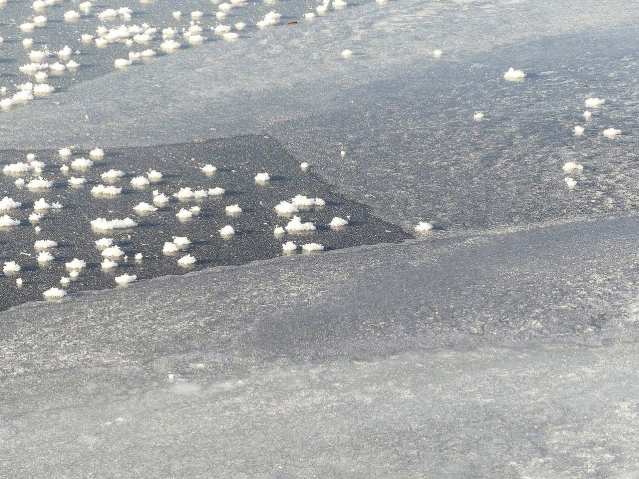
All in all, what we’re really looking at is a relationship between the lake and the sky.
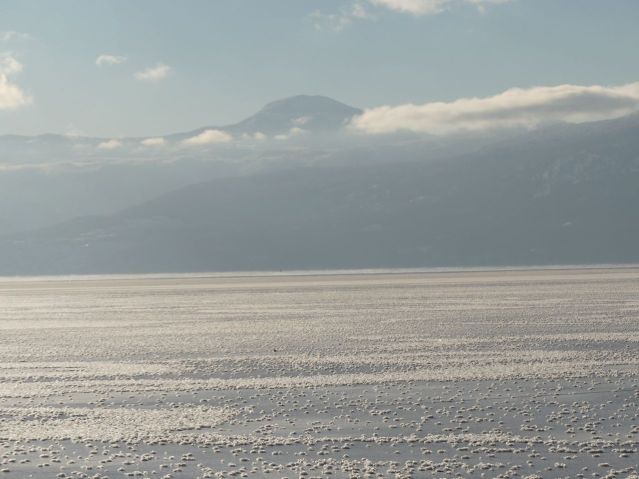
And the sun.
And the wind.

With the geese …

…as tricksters in the process.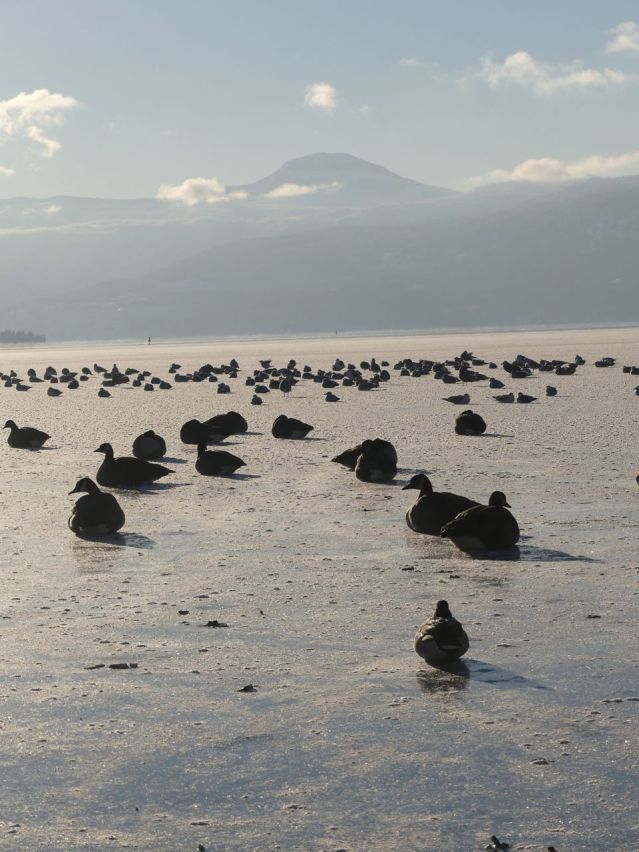
Poor things. I told them that migration might have been a good option. They barely had the energy to hiss. Still, a few things are easy enough to observe. First, hoarfrost is heating in the sun and evaporating into the air, despite the cold (and the geese.)
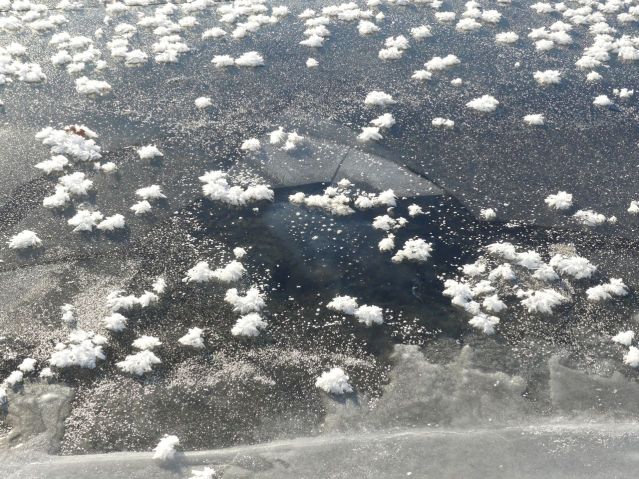 Second, it is drifting on a breeze and condensing again. These two effects don’t have to happen at the same time.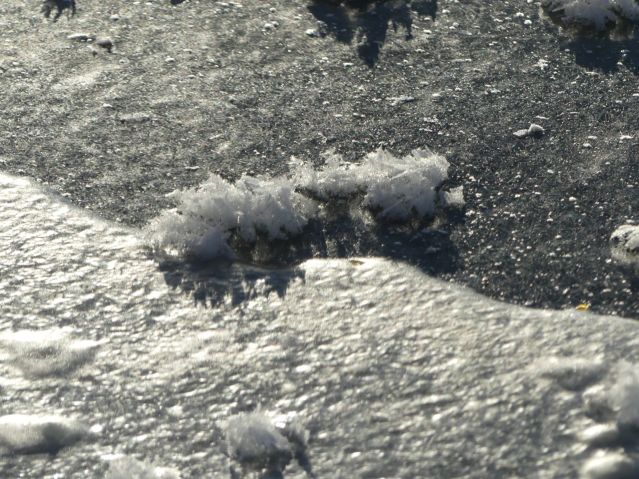
It’s likely that the clear, dry, high pressure sky is absorbing the evaporated frost, which was likely laid down when fog moved in off the open part of the lake at night.
Third, this frost holds the directionality of the wind, and forms in incredibly thin structures. Likely, this shape that allows them to melt despite the cold, and evaporate into the dry air.
To rephrase all that: darkness and cold bring the heat of summer across the ice, where the heat drops away to leave water behind; together the sun and the night move water across the ice and deposit it (store it), for later release. All of this couldn’t happen without a sky that has been stripped of water by its journey over the mountains to the west, and which creates a pressure vacuum, a kind of wing, that accelerates the evaporation process. After all, if the sky were heavy with humidity, it would simply snow. Now, let’s place this activity into context. There is frost moving across the lake, storing energy and releasing it across time…

… and there are leaves, trading electrons across a membrane to create sugar …

and there are lungs that trade gasses from air to blood by pressure differences, photovoltaic cells that trade electrons across a threshold and there are nuclear reactors that knock atoms apart so they can reassemble, in a process controlled by temperature and pressure. There is, in other words, the shifting of material across space and time by utilizing energy shifts across thresholds of form. The processes can be complex, but they’re also elegantly simple. The surface of the lake, for instance…

… which is made out of the intermolecular and surface tension of innumerable molecules of water (in other words out of an atomic charge)…
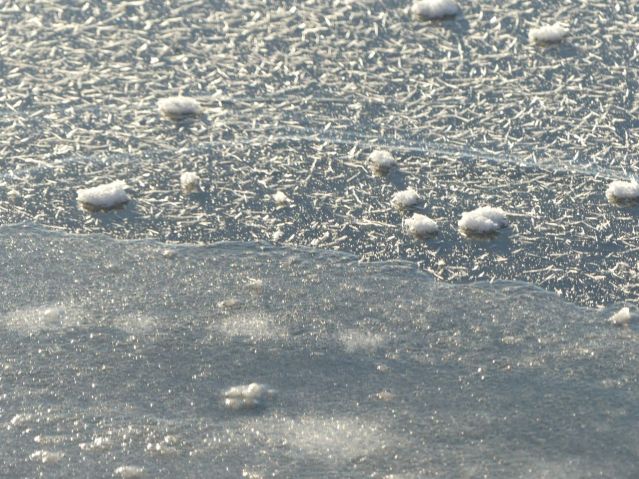
…is a plane of energy on a particular wavelength between water and air, which invites frost to form little differently than the way in which a leaf manipulates carbon dioxide and water atoms to transfer electrons across a membrane by inviting molecules to sit in just the right position that further atoms slide into the correct places for building sugar, and no other. It is a passive process, but a powerful one.
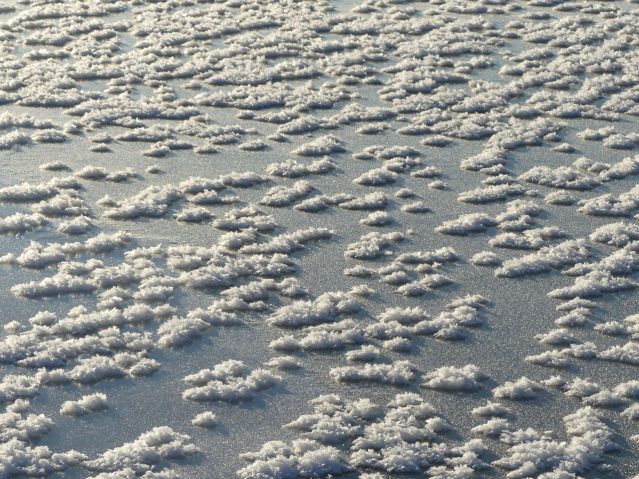
There is nothing in the process that could not be managed to create, store and move energy in a landscape, and nothing in it that could not be used to create technologies that would do the same in built environments. This is an atomic reactor at work:
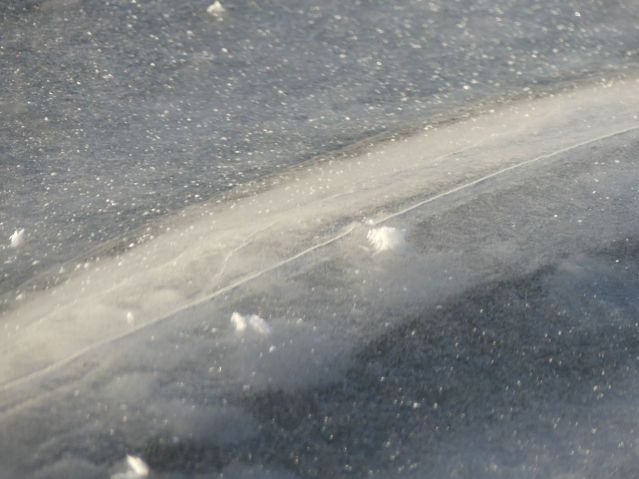
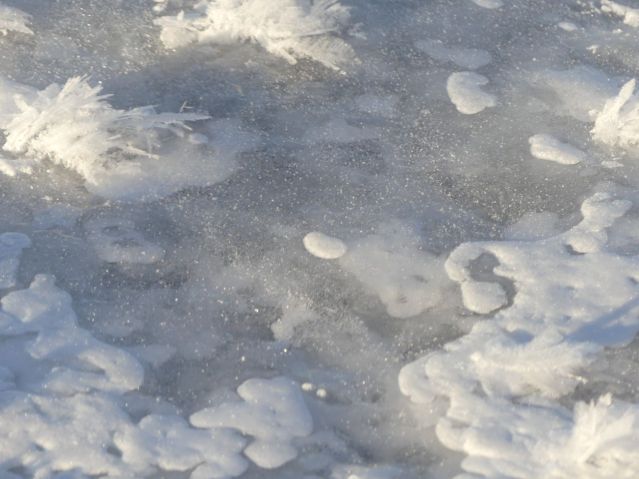
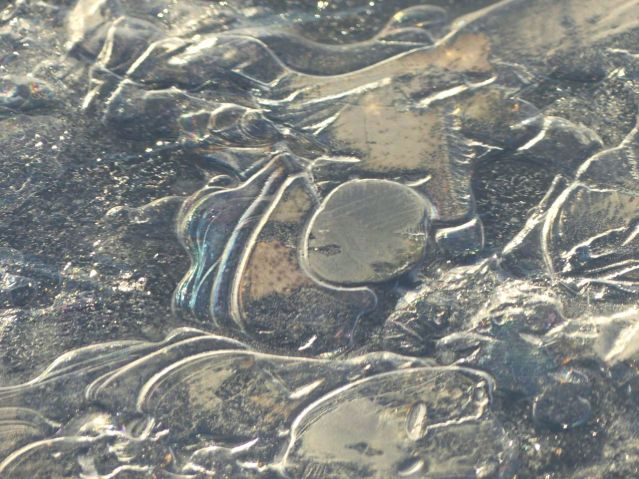
That it is not seen as one is probably because scientific traditions are built around measurement by devices, with the goal of building further independent devices, on the model of the independent human observers who implement them. They could, however, be built instead around environments, with the goal of building further environments, on the model of the biological observers who implement them.

Using our valley to manipulate heat and cold, pressure and water through the cooling and evaporative process available to us, driven by the energy wing of the mountains, would lead to a situation in which this slope of the lake …
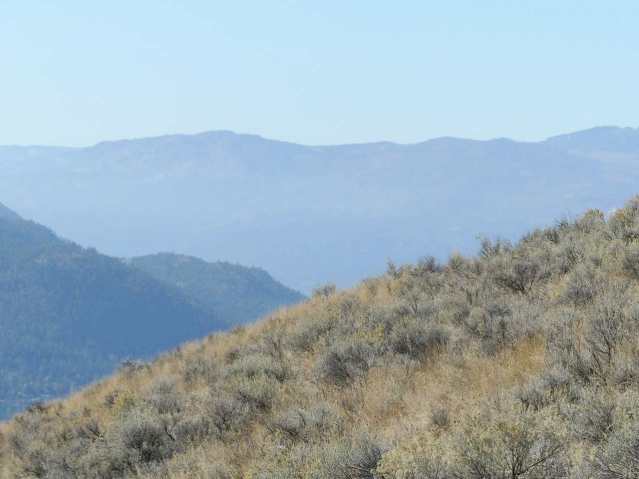
… is, like the lake, the reactor. It wouldn’t look like this, of course, all weed-choke, because it would be managed for energy effects. In this context, the sage brush below …

… is frost which has condensed as a reaction to a pressure environment …
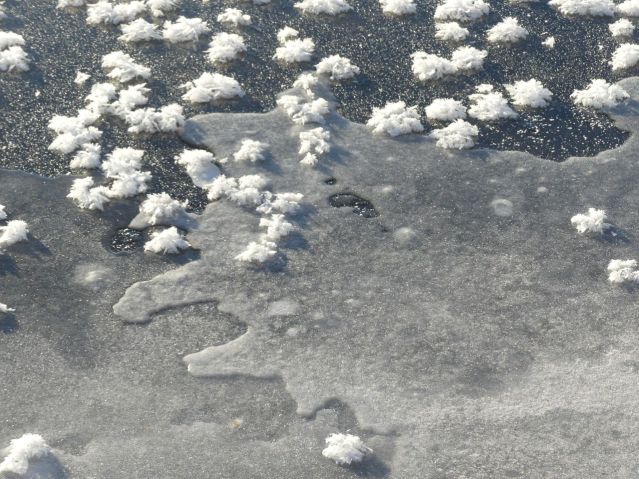
and this bunch grass…
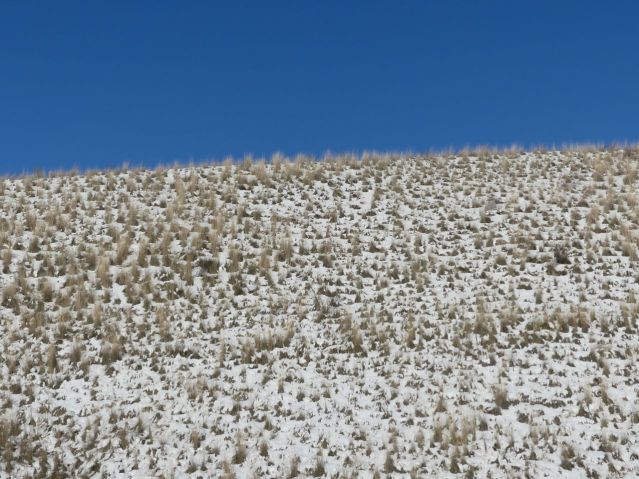
… is a complex device that uses a column of evaporated water to hold water against both the gravity within the soil and the pressure effect (also a gravity effect) in the air. In other words, this particular atomic reactor is a gravity reactor. If we use it wisely, there will be water for all.

If we don’t, the water will blow away in the wind.

An Okanagan university would be working on these processes day and night.
Categories: Arts, Atmosphere, Earth, Gaia, Industry, Nature Photography, Science, Water

 Okanagan Okanogan