


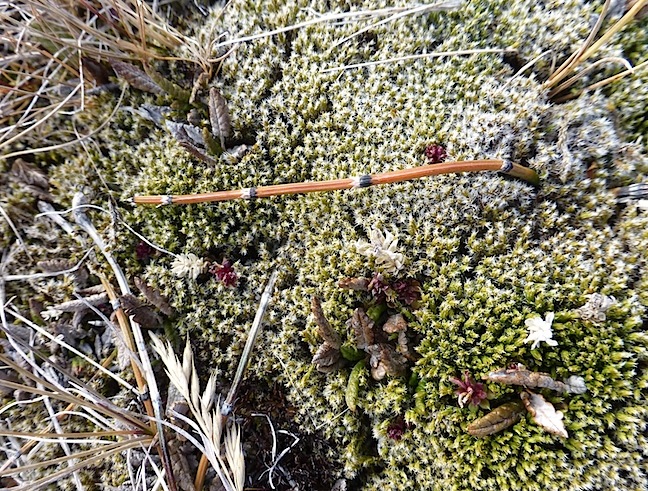
Humans are addicted. This group of highly social animals that operates on the assumption that it has free will is as tightly a part of ecosystems as the plants in this image from Iceland:
 A Little Icelandic World on a Sheep Hill
Colonizing a tuft of sub-arctic bunchgrass … no doubt close to 1100 years of sheep mounching has had something to do with this turn of events.
The thing is, that for humans this ecosystem is social as well as physical, and sometimes both at once. Global warming, for instance, is not an accident. It is the direct result of thinking chemically and technologically. That image above is not what the tuft looks like to human eyes. It’s just how it looks like to human eyes after being filtered through a particular device, processed according to a particular set of algorhythms scripted to approximate how it looks to human eyes, and projected on a certain kind of electronic screen. In the old days, poetry operated like this. Now it’s this little process. There’s more. The medium has its own demands. These include the power to go closer, which human eyes can’t do, like this…
This ability of technology is linked to a powerful, unseen effect of the technology: it isolates and frames. What was a unified world has now become a thing of beauty and an arrangement of abstract shapes and colour. A human eye chose that, working within its own processes and the boundaries set by a particular technology. That’s how art works. That’s how humans work, negotiating both physical and social universes at the same time. This is such an elemental process to humans that it is out of this that they make their art. However, there is also this:

The Same Image on Drugs
Humans are oriented to light in the way dogs are oriented to scent and mosquitoes are oriented to carbon dioxide. It should, thus, be no surprise that the settings of most cameras today, and most publicity photos intended to grab human attention, are set with intensified colour values. It’s not how the world works, it’s not how the world looks, but it is how the human mind works, amplified, at loud volume … just that this volume has to do with light. Here are the images together:

Compared to the image on the right, the one on the left looks boring, although it is closer to the world perceived by human bodies. How, I ask, can humans live on the earth when the common language they have with which to speak with each other is a kind of biological shouting lifted into a social sphere? Sure, it’s how humans speak with each other when they are thrown out of their social worlds into a global one in which there appears at times to be nothing left but physical commonality and individual identity. That’s logical. This man felt the same thing in 1916…
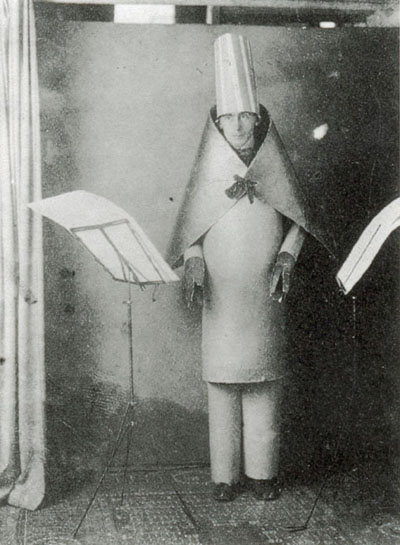
Hugo Ball, Dadaist
Together with a group of war exiles in Zürich he was convinced that art and war were the same thing … and set out to turn art into something else. A year later, when the war was still going on, he scripted this performance piece about the meaninglessness of language …
 To no avail. War came back, and now this is known as art. In fact, today, in Canada, the reverence for this tradition is still called the “avante garde” — a military term from the First World War, that once meant the men in the front of the front lines, who blazed the way for society through the barbed wire, and now means … an artistic tradition. If all that human culture can do at the moment is stare at itself, and its most basic physiological processes, in a mirror, no wonder there is global warming. Humans are mammals. Like mice, they like to be warm. I’ll leave you with a thought: “biological shouting lifted into a social sphere” (my words above)… that is the Germany of 1933-1945. Here it is 5 years earlier than that, when it was still being rehearsed.
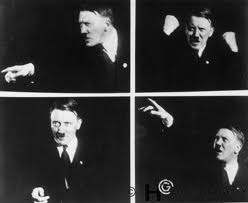
Hitler Rehearsing His Speeches, 1928
It is easy to find analyses of how German psychologists, let’s say, were puzzled that on trips to the United States in, say, 1935, scientists at Harvard were amazed to hear the Germans speaking earnestly and scientifically about the “Führer Principal” organizing itself in petri dishes full of bacteria that the Americans, thinking earnestly and scientifically, saw as operating randomnly, in full accord with American ideas of political organization. The German and American scientists were only reacting to the social world around them. The same thing is happening today. Humans are now on a different but related and equally powerful drug. What next? I’m worried. And what is human? Given human abilities at creating artificial models of themselves within artificial environments, at the expense of the earth, I think it’s a good time to ask it again.
Categories: Arts, Global Warming, Industry, Nature Photography

 Okanagan Okanogan